
Employee Onboarding Software: 20 Best Platforms for 2025
Compare the best employee onboarding software platforms with this in-depth guide. Learn key features, benefits, pricing, and how to choose the right onboarding software for your organization.

Organizations must prioritize employee onboarding to integrate new hires successfully. Effective onboarding will help new employees feel connected to your company early on, which helps retention down the road. The right onboarding can also help new hires hit the ground running to make an impact at your organization more quickly. Employee onboarding software streamlines this process by automating tasks, facilitating compliance, and enhancing the overall experience for newcomers. According to EMP Trust HR, only 12% of employees feel their organization does a good job of onboarding.
By leveraging employee onboarding tools, companies not only boost productivity but also foster long-term commitment from their employees.In this guide we’ll explore the top employee onboarding tools available.
What Are the Best 20 Employee Onboarding Software Platforms?
- Lumos
- BambooHR
- Workday
- Rippling
- Whatfix
- Gusto
- Onboard by HR Cloud
- Efficient Hire
- WorkBright
- Paycor
- Talmundo
- Clustdoc
- Greenhouse
- ClearCompany
- Hibob
- Lever
- Deel
- Zoho People
- Namely
- Justworks
Key Features to Look for in Onboarding Software
Selecting the right employee onboarding software is crucial for streamlining HR operations, improving compliance, and enhancing the new hire experience. IT and security leaders must evaluate software platforms based on their ability to automate administrative tasks, provide self-service capabilities, and integrate with existing HR systems. Below are the key features to consider when choosing the best onboarding solution.
- Automated Workflow and Task Management
- Customizable Onboarding Templates
- Paperless Document Management
- E-Signature Integration
- Employee Self-Service Portals
- Compliance Tracking and Management
- Integration Capabilities with HRIS and Payroll Systems
- Analytics and Reporting Tools
- Mobile Accessibility
Automated Workflow and Task Management
One of the most valuable features of modern employee onboarding tools is automation. Automated workflow management ensures that HR teams don’t have to manually track each step of the onboarding process. Instead, pre-configured workflows can:
- Assign tasks to relevant team members (HR, IT, managers).
- Send automated reminders for pending paperwork or training.
- Trigger system access requests for IT provisioning.
By automating routine tasks, organizations reduce administrative overhead, prevent onboarding delays, and create a smoother, more engaging experience for new employees.
Customizable Onboarding Templates
Every company has unique onboarding needs, and customizable templates allow HR teams to tailor workflows for different roles, departments, or locations. Personalized onboarding ensures that:
- Employees receive role-specific training and policy documents.
- Managers can modify the onboarding experience based on department needs.
- Companies maintain branding consistency in welcome emails and training materials.
With employee onboarding software offering drag-and-drop templates, HR teams can standardize yet personalize onboarding journeys for new hires.
Paperless Document Management
Gone are the days of paper-based onboarding. Digital employee onboarding software provides centralized document storage, making it easier for HR teams to:
- Collect, store, and retrieve important HR paperwork.
- Securely manage tax forms, NDAs, and employment contracts.
- Ensure compliance by maintaining a digital audit trail.
This reduces administrative burden and ensures that companies remain compliant with data retention policies and regulatory requirements.
E-Signature Integration
Onboarding typically involves signing multiple documents, from offer letters to tax forms. E-signature integration speeds up this process by allowing employees to:
- Sign forms remotely and securely from any device.
- Reduce onboarding time from days to minutes.
- Eliminate printing, scanning, and mailing delays.
By using built-in e-signature capabilities, HR teams can create a frictionless, paperless onboarding experience.
Employee Self-Service Portals
A self-service onboarding portal empowers employees to:
- Access their onboarding checklists independently.
- Upload required documents and complete HR forms.
- Track progress on required training or tasks.
Providing employees with control over their own onboarding journey improves engagement, reduces HR workload, and ensures a smoother first-day experience.
Compliance Tracking and Management
Compliance is a top priority in onboarding. Onboarding employee software should include:
- Automated compliance tracking for background checks and certifications.
- Alerts for expiring documents (e.g., I-9 forms, work permits).
- Built-in security protocols for GDPR, HIPAA, or SOC 2 compliance.
By automating compliance tracking, organizations reduce legal risks and stay ahead of changing labor regulations.
{{shadowbox}}
Integration Capabilities with HRIS and Payroll Systems
For a frictionless onboarding process, employee onboarding software must integrate with existing HR tech stacks, including:
- HRIS (Human Resource Information Systems) for storing employee records.
- Payroll software for automatic salary and tax setup.
- Identity and access management tools for IT security compliance.
Integration ensures data consistency, eliminates manual data entry, and improves cross-functional coordination.
Analytics and Reporting Tools
HR teams need real-time analytics to measure onboarding success. Robust reporting features can provide insights into:
- Time-to-productivity metrics (how quickly employees complete onboarding).
- Completion rates for training and compliance documentation.
- Employee engagement scores based on feedback surveys.
By tracking key onboarding performance indicators, organizations can refine their onboarding process for future hires.
Mobile Accessibility
With remote and hybrid work environments on the rise, onboarding solutions must be mobile-friendly. Employees should be able to:
- Complete onboarding tasks from their smartphones.
- Sign documents on-the-go.
- Access self-service portals from any device.
A mobile-first approach ensures that employees can onboard anytime, anywhere, making the process more convenient and efficient.
When choosing employee onboarding software, IT and HR leaders must prioritize automation, compliance, and seamless integration. A platform with customizable workflows, self-service portals, and analytics capabilities will not only improve the new hire experience but also drive long-term organizational efficiency.
Benefits of Implementing Onboarding Software
Implementing employee onboarding software is no longer just an HR convenience—it’s a necessity for organizations looking to streamline workflows, enhance compliance, and improve the overall employee experience.
By automating administrative tasks and providing structured onboarding journeys, businesses can increase retention, improve engagement, and save both time and money. Below are some of the key benefits of using onboarding employee software.
Streamlined Administrative Processes
One of the biggest advantages of employee onboarding software is the automation of administrative tasks. Traditionally, HR teams had to manually track new hire paperwork, send reminders, and coordinate training sessions—leading to inefficiencies and bottlenecks. With automated employee onboarding software, organizations can:
- Auto-assign tasks to HR, IT, and managers.
- Send automatic reminders for pending forms, compliance training, or document uploads.
- Generate workflows that ensure each step in the onboarding process is completed on time.
By automating onboarding, HR teams can focus on more strategic initiatives rather than being bogged down by repetitive tasks. This results in faster onboarding, reduced errors, and a more organized approach to welcoming new employees.
Enhanced New Hire Experience
A well-structured onboarding experience has a direct impact on employee satisfaction and long-term engagement. Instead of overwhelming new hires with endless paperwork and information overload, digital employee onboarding software provides:
- Interactive onboarding portals where employees can self-guide through company policies, team introductions, and training materials.
- Step-by-step checklists that break down the onboarding process into manageable tasks.
- Personalized onboarding journeys based on job role, department, or location.
A modern, engaging onboarding experience makes employees feel more welcomed, better informed, and empowered to start their new role with confidence.
Improved Compliance and Record-Keeping
Compliance is critical, especially when dealing with labor laws, data privacy regulations, and industry-specific requirements. Employee onboarding process software ensures that businesses remain compliant by:
- Tracking onboarding progress in real-time.
- Auto-flagging missing documents or incomplete compliance training.
- Securely storing digital records for audits and legal documentation.
With automated compliance tools, businesses reduce legal risks, eliminate paperwork errors, and ensure that every new hire meets regulatory requirements.
Increased Employee Engagement and Retention
A disorganized or incomplete onboarding process can leave new hires feeling disconnected, leading to higher turnover rates. Employee onboarding and training software helps organizations:
- Provide a clear roadmap for new hires, reducing uncertainty.
- Foster early engagement through social introductions, company culture insights, and training sessions.
- Align employee expectations with company goals from day one.
By investing in structured onboarding, businesses increase engagement and create long-term employees who feel valued and prepared for success.
Time and Cost Efficiency
Manual onboarding processes are not only time-consuming but also costly. Lost productivity, paperwork errors, and administrative overhead can significantly impact a company’s bottom line. By adopting automated onboarding software, organizations can:
- Reduce HR workload, freeing up time for more strategic initiatives.
- Eliminate unnecessary printing and mailing costs with paperless digital onboarding.
- Shorten the time-to-productivity for new hires by automating IT provisioning, training assignments, and system logins.
By improving efficiency, onboarding software helps businesses scale their hiring processes while reducing operational costs.
Challenges in Implementing Onboarding Software
While employee onboarding software offers numerous benefits—such as automation, improved compliance, and enhanced new hire experiences—its implementation is not without challenges. IT and security leaders must address common hurdles such as data migration, user adoption, software integration, and cybersecurity risks to ensure a seamless transition. Below, we explore these challenges and provide strategies to overcome them.
Data Migration Issues
One of the biggest technical challenges in implementing employee onboarding process software is data migration. Many organizations have vast amounts of HR data stored in multiple legacy systems, including:
- Employee records and personal details
- Compliance documents (NDAs, tax forms, certifications)
- Training history and performance evaluations
Transferring this data into a new onboarding platform can be complex, as different systems may have incompatible data formats or incomplete records. Some best practices for a smooth data migration include:
- Conducting a data audit to clean and standardize existing records.
- Using data mapping tools to align fields between old and new systems.
- Running test migrations to identify and fix errors before full deployment.
By carefully planning data migration strategies, organizations can prevent disruptions and ensure a seamless transition to digital employee onboarding software.
User Adoption Resistance
New technology adoption often meets resistance, especially when employees are accustomed to manual onboarding processes. Some common concerns include:
- HR teams fearing job displacement due to automation.
- Managers and employees prefer familiar onboarding methods.
- Employees struggling with new software interfaces.
To drive user adoption, organizations should:
- Offer hands-on training for HR teams and managers.
- Provide clear documentation and step-by-step guides for employees.
- Choose user-friendly software with an intuitive interface.
- Encourage feedback to continuously refine the onboarding experience.
By ensuring proper training and support, companies can reduce resistance and maximize the benefits of onboarding automation tools.
Integration Complexities
Seamless software integration is crucial for HR onboarding platforms to function efficiently. However, many organizations face challenges when integrating onboarding software with existing tools, such as:
- HRIS (Human Resource Information Systems)
- Payroll software
- Identity and access management (IAM) solutions
Common integration issues include:
- Incompatible APIs that prevent data synchronization.
- Duplicate or missing employee records due to improper data mapping.
- Slow performance caused by excessive API calls or outdated systems.
To overcome these challenges, organizations should:
- Verify API compatibility before choosing an onboarding solution.
- Work with IT teams to create custom integration scripts if needed.
- Use middleware solutions that bridge the gap between different HR systems.
Proactively addressing integration issues ensures a seamless flow of employee data across platforms and minimizes onboarding delays.
Maintaining Data Security and Privacy
With employee onboarding and training software handling sensitive personal data, cybersecurity is a top concern. Organizations must protect new hire information such as:
- Social Security numbers (SSNs)
- Banking details for payroll
- Confidential employment contracts
Some key cybersecurity best practices for onboarding software include:
- Implementing role-based access controls (RBAC) to restrict data access.
- Encrypting sensitive data both in transit and at rest.
- Using multi-factor authentication (MFA) for added security.
- Regularly auditing security logs to detect unauthorized access.
By following strict data security protocols, IT and security leaders can ensure compliance with GDPR, HIPAA, and other data privacy regulations.
Top 20 Employee Onboarding Software Solutions
Choosing the right employee onboarding software is essential for streamlining HR processes, improving compliance, and enhancing the new hire experience. With so many options available, it’s important to compare platforms based on key features, pricing, integration capabilities, and overall ease of use.
Whether you’re a small business looking for cost-effective onboarding tools or a large enterprise in need of scalable solutions, this guide will help you find the best fit for your organization.
Here are the top 17 employee onboarding software solutions available right now:
- Lumos
- BambooHR
- Workday
- Rippling
- Whatfix
- Gusto
- Onboard by HR Cloud
- Efficient Hire
- WorkBright
- Paycor
- Talmundo
- Clustdoc
- Greenhouse
- ClearCompany
- Hibob
- Lever
- Deel
- Zoho People
- Namely
- Justworks
1. Lumos
Lumos is a modern identity and access management (IAM) solution that streamlines employee onboarding by automating access provisioning, ensuring compliance, and providing deep visibility into user permissions. Designed to enhance security while improving efficiency, Lumos enables IT and HR teams to manage onboarding workflows seamlessly, reducing manual efforts and security risks.
- G2 rating: 4.8/5
- Price: Starts at $1/month per user (varies by feature set)
- Best for: Mid-size and enterprise organizations looking to automate employee lifecycle management, streamline self-service access requests, accelerate user access reviews and cut down app spend wastage.

Lumos simplifies the onboarding process by automating role-based access provisioning and ensuring that new hires have the right tools and permissions from day one. By integrating with HRIS, ITSM, and SaaS applications, Lumos eliminates access bottlenecks and reduces security vulnerabilities associated with excessive permissions.
Key Features:
- Automated Access Provisioning – Instantly grants new employees access to necessary apps and systems based on predefined roles.
- Least-Privilege Access Management – Ensures that users only receive the minimum permissions required for their role.
- HRIS and ITSM Integration – Syncs with HR and IT platforms to automate user onboarding and offboarding workflows.
- Access Review and Compliance Audits – Provides real-time visibility into permissions and automates compliance reviews.
- Self-Service Access Requests – Allows employees to request and manage their own access, reducing IT workload.
- Security Policy Enforcement – Implements zero-trust security principles to prevent unauthorized access and insider threats.
Lumos is an ideal choice for IT and security leaders looking to streamline onboarding, improve security posture, and automate access management without adding complexity to existing workflows.
2. BambooHR
BambooHR is a comprehensive HR software designed to simplify employee onboarding, HR management, and payroll processing for small to mid-sized businesses. With its user-friendly interface and automated workflows, BambooHR helps HR teams streamline onboarding, ensuring that new hires have a seamless and engaging first-day experience.
- G2 rating: 4.5/5
- Price: Custom pricing based on organization size and features
- Best for: Small to mid-sized businesses looking for an all-in-one HR and onboarding solution

BambooHR’s onboarding module allows HR teams to digitize paperwork, create personalized onboarding experiences, and automate administrative tasks. Its intuitive platform reduces manual HR workload, helping organizations improve efficiency while maintaining compliance with labor laws and company policies.
Key Features:
- Automated Onboarding Workflows – Streamlines onboarding by automating task assignments, paperwork completion, and welcome emails.
- E-Signature Integration – Enables paperless document signing, reducing administrative delays.
- Self-Service Employee Portal – Allows new hires to complete tasks, access company policies, and update personal information independently.
- Customizable Onboarding Checklists – Ensures consistency in onboarding processes across different departments.
- HRIS and Payroll Integration – Seamlessly connects with payroll and HR systems to sync employee data.
- Employee Engagement Tools – Includes surveys and feedback tools to track onboarding success.
3. Workday
Workday is a cloud-based HR and financial management platform that provides a solid employee onboarding solution for enterprises. Designed for scalability and automation, Workday streamlines HR workflows, ensures compliance, and offers deep analytics to help organizations optimize their onboarding processes.
- G2 rating: 4.3/5
- Price: Custom pricing based on enterprise needs and modules selected
- Best for: Large enterprises needing comprehensive HR, payroll, and onboarding automation

Workday’s onboarding solution integrates with HR, payroll, and IT systems, ensuring that new hires receive the right permissions, benefits, and training from day one. Its AI-driven automation and analytics help HR leaders track onboarding progress, improve engagement, and reduce administrative workload.
Key Features:
- Automated Onboarding Workflows – Assigns onboarding tasks, tracks progress, and ensures compliance with company policies.
- AI-Powered Employee Insights – Uses data analytics to measure onboarding effectiveness and optimize workflows.
- Seamless HRIS Integration – Connects with payroll, benefits administration, and talent management systems.
- Self-Service Employee Portal – Allows new hires to access company resources, complete tasks, and engage with their team.
- Learning Management System (LMS) Integration – Provides role-based training modules for new employees.
- Mobile Accessibility – Enables onboarding on-the-go through the Workday mobile app.
4. Rippling
Rippling is an all-in-one HR, IT, and finance platform that simplifies employee onboarding by automating HR processes, payroll, and IT provisioning. Designed for fast-growing businesses, Rippling ensures that new hires have access to the tools, benefits, and accounts they need from day one.
- G2 rating: 4.8/5
- Price: Starts at $8/month per user (varies by features and modules)
- Best for: Small to mid-sized businesses looking for an integrated HR, IT, and payroll solution

Rippling stands out by automating not only HR tasks but also IT setup, such as email creation, software provisioning, and device management. This makes it a great choice for companies that need a seamless onboarding experience that covers both HR and IT operations.
Key Features:
- Automated Onboarding Workflows – Instantly assigns tasks, sends paperwork, and configures system access.
- IT and Software Provisioning – Automatically sets up work emails, Slack, Zoom, and other work tools for new hires.
- Payroll and Benefits Integration – Syncs employee onboarding data directly with payroll and benefits platforms.
- Device Management – Configures and secures laptops and mobile devices for employees.
- Customizable Onboarding Checklists – Ensures a structured, role-based onboarding experience.
- Compliance Tracking – Helps HR teams manage tax forms, NDAs, and employment contracts.
5. Whatfix
Whatfix is a digital adoption platform (DAP) that enhances employee onboarding, training, and software adoption by providing in-app guidance and interactive learning experiences. It is designed to help organizations accelerate onboarding, reduce training costs, and improve employee productivity by integrating directly into existing business applications.
- G2 rating: 4.6/5
- Price: Custom pricing based on organization size and feature needs
- Best for: Enterprises looking to enhance software onboarding and user adoption with in-app guidance

Whatfix streamlines the onboarding experience by offering real-time walkthroughs, contextual help, and self-service resources embedded within enterprise applications. This enables new employees to learn as they work, reducing the need for lengthy training sessions and improving knowledge retention.
Key Features:
- In-App Guidance and Walkthroughs – Provides step-by-step, interactive training within business applications.
- Self-Service Knowledge Base – Allows employees to access on-demand help and documentation.
- Automated Onboarding Workflows – Ensures new hires complete training modules and tasks efficiently.
- Integration with HR & Learning Management Systems (LMS) – Connects with existing onboarding and training platforms.
- Analytics and User Behavior Insights – Tracks engagement and identifies areas for improvement in onboarding processes.
- Multi-Device Compatibility – Works seamlessly across desktop, web, and mobile applications.
6. Gusto
Gusto is an all-in-one HR, payroll, and benefits platform designed to simplify employee onboarding and workforce management for small to mid-sized businesses. With its user-friendly interface and automation features, Gusto streamlines HR operations, ensuring a smooth and efficient onboarding process for new hires.
- G2 rating: 4.5/5
- Price: Starts at $6/month per user (varies by plan and features)
- Best for: Small to mid-sized businesses looking for a cost-effective, automated HR and payroll solution

Gusto helps HR teams reduce administrative workload by automating onboarding tasks, including paperwork collection, tax form submissions, and benefits enrollment. Its integration with payroll and compliance tracking tools makes it a great choice for businesses looking to combine HR and payroll into one intuitive platform.
Key Features:
- Automated Employee Onboarding – Guides new hires through paperwork, tax forms, and benefits selection.
- E-Signature Integration – Enables paperless document signing for a seamless onboarding experience.
- Payroll and Benefits Management – Automatically syncs employee data with payroll and benefits systems.
- Self-Service Employee Portal – Allows new hires to manage their own onboarding tasks, tax documents, and benefits enrollment.
- Compliance and Tax Filing Automation – Ensures businesses remain compliant with labor laws and tax regulations.
- Direct Integration with Accounting Software – Works with QuickBooks, Xero, and other accounting tools.
7. Onboard by HR Cloud
Onboard by HR Cloud is a dedicated employee onboarding platform designed to help HR teams streamline the onboarding process, automate administrative tasks, and enhance new hire engagement. With its customizable workflows and seamless integrations, Onboard ensures that employees feel welcomed and prepared from day one.
- G2 rating: 4.4/5
- Price: Custom pricing based on company size and feature needs
- Best for: HR teams and mid-sized businesses looking for an interactive and automated onboarding experience

Onboard reduces manual onboarding efforts by providing preboarding capabilities, self-service portals, and compliance tracking tools. Its intuitive platform allows HR teams to automate document management, facilitate team introductions, and personalize the onboarding journey for each new hire.
Key Features:
- Automated Onboarding Workflows – Assigns tasks, tracks progress, and sends reminders.
- Preboarding Experience – Engages new hires before their first day with company introductions and paperwork.
- E-Signature Integration – Supports paperless document signing for a seamless process.
- Self-Service Employee Portal – Allows employees to complete onboarding checklists, upload documents, and access training materials.
- HRIS and Payroll Integrations – Syncs with HR and payroll systems for a smooth transition.
- Compliance and Document Tracking – Ensures all onboarding paperwork is completed and securely stored.
8. Efficient Hire
Efficient Hire is a cloud-based employee onboarding and workforce management platform designed to streamline HR processes, automate paperwork, and ensure compliance. Ideal for high-volume hiring industries, Efficient Hire simplifies onboarding, tax credit processing, and employee communication to reduce administrative workload.
- G2 rating: 4.3/5
- Price: Custom pricing based on business size and hiring volume
- Best for: Businesses with high-volume hiring needs, including retail, hospitality, and healthcare

Efficient Hire automates onboarding workflows, allowing HR teams to reduce manual data entry, ensure compliance, and onboard employees quickly and efficiently. Its mobile-friendly platform enables new hires to complete paperwork and training from anywhere, making it a great choice for distributed and remote workforces.
Key Features:
- Automated Onboarding Workflows – Reduces paperwork by automating new hire forms, tax documents, and company policies.
- E-Signature Integration – Supports digital document signing for a paperless onboarding process.
- Work Opportunity Tax Credit (WOTC) Screening – Helps businesses maximize tax credits for eligible employees.
- Mobile-Optimized Self-Service Portal – Allows employees to complete onboarding tasks on any device.
- HR and Payroll System Integration – Syncs with leading payroll, HRIS, and ATS platforms.
- Compliance and Document Tracking – Ensures that state and federal employment regulations are met.
9. WorkBright
WorkBright is a mobile-first employee onboarding software designed to help companies digitize paperwork, automate HR workflows, and onboard employees remotely. With a focus on paperless onboarding and compliance, WorkBright is ideal for organizations that need to hire and onboard employees quickly and efficiently.
- G2 rating: 4.6/5
- Price: Custom pricing based on company size and hiring volume
- Best for: Companies with remote or high-volume hiring needs, including healthcare, construction, and seasonal workforces

WorkBright simplifies onboarding by enabling new hires to complete forms, sign documents, and upload certifications from their mobile devices. Its automated reminders and compliance tracking help HR teams ensure all paperwork is completed before an employee’s start date.
Key Features:
- Mobile-Optimized Onboarding – Allows employees to complete paperwork on any device, reducing onboarding time.
- E-Signature Integration – Enables paperless document signing for tax forms, contracts, and policies.
- Photo Upload for Certifications & IDs – Employees can securely upload IDs, licenses, and certifications using their smartphone camera.
- Automated Reminders & Follow-Ups – Ensures all onboarding tasks are completed before an employee’s first day.
- Compliance Tracking & Secure Document Storage – Helps businesses meet employment law requirements and maintain organized records.
- HRIS & Payroll Integration – Syncs onboarding data with payroll and HR platforms for a seamless transition.
10. Paycor
Paycor is an HR and payroll platform that provides automated employee onboarding, payroll processing, and workforce management solutions. Designed for small to mid-sized businesses, Paycor helps HR teams streamline hiring, reduce administrative burden, and ensure compliance throughout the onboarding process.
- G2 rating: 4.3/5
- Price: Custom pricing based on company size and selected features
- Best for: Small to mid-sized businesses looking for a combined HR, payroll, and onboarding solution

Paycor simplifies employee onboarding by integrating HR, payroll, and compliance tracking into a single, easy-to-use platform. Its automated workflows ensure that new hires complete paperwork, enroll in benefits, and gain system access seamlessly.
Key Features:
- Automated Onboarding Workflows – Guides new hires through paperwork, tax forms, and benefits enrollment.
- E-Signature Integration – Supports digital document signing for a paperless onboarding experience.
- Payroll & Benefits Integration – Syncs onboarding data directly with payroll and benefits management systems.
- Self-Service Employee Portal – Enables employees to complete tasks, access documents, and update personal information.
- Compliance & Tax Filing Automation – Ensures compliance with state and federal regulations through automated reporting.
- HR & Performance Management Tools – Extends beyond onboarding with time tracking, performance reviews, and compensation management.
11. Talmundo
Talmundo is an AI-driven employee onboarding platform designed to modernize and streamline onboarding experiences for global organizations. With an emphasis on engagement, automation, and compliance, Talmundo helps HR teams create personalized and structured onboarding journeys for new hires.
- G2 rating: 4.4/5
- Price: Custom pricing based on company size and features
- Best for: Large enterprises looking for interactive, AI-powered onboarding experiences

Talmundo enhances new hire engagement by delivering customizable onboarding portals, task automation, and interactive learning modules. Its AI-powered features help HR teams track onboarding progress, assess employee sentiment, and optimize workflows for future hires.
Key Features:
- Personalized Onboarding Journeys – Customizes the onboarding process based on role, location, and department.
- AI-Powered Analytics & Insights – Uses AI to track employee sentiment and engagement levels.
- Task Automation & Compliance Tracking – Ensures timely completion of forms, training, and legal documentation.
- Interactive Learning Modules – Provides engaging, self-paced training and onboarding content.
- Mobile-Optimized Self-Service Portal – Allows new hires to complete onboarding tasks on any device.
- HR System & Payroll Integration – Seamlessly connects with HRIS, payroll, and IT systems.
12. Clustdoc
Clustdoc is a document collection and onboarding automation platform designed to streamline new hire paperwork, compliance tracking, and task management. Ideal for businesses that require structured document workflows, Clustdoc helps HR teams digitize onboarding, improve efficiency, and ensure regulatory compliance.
- G2 rating: 4.7/5
- Price: Starts at $70/month for small teams (varies by features and users)
- Best for: Organizations that require a document-driven onboarding process with automated approvals and compliance tracking

Clustdoc simplifies employee onboarding by providing a centralized platform for collecting, reviewing, and approving onboarding documents. Its custom workflows and automation tools help businesses ensure new hires complete required paperwork efficiently while maintaining data security.
Key Features:
- Automated Document Collection & Approvals – Digitizes onboarding paperwork with e-signatures and automated approvals.
- Custom Onboarding Workflows – Creates structured checklists to ensure all required steps are completed.
- Self-Service Employee Portal – Allows new hires to upload, review, and submit documents easily.
- Compliance & Data Security – Ensures adherence to GDPR, HIPAA, and other regulatory standards.
- Collaboration & Messaging Tools – Enables real-time HR-to-employee communication within the platform.
- HR & Payroll Integrations – Syncs with existing HR systems and applicant tracking software (ATS).
13. Greenhouse
Greenhouse is a hiring and onboarding platform that helps organizations streamline recruitment, improve new hire experiences, and automate onboarding tasks. Known for its robust applicant tracking system (ATS) and structured hiring workflows, Greenhouse ensures a seamless transition from candidate to employee.
- G2 rating: 4.4/5
- Price: Custom pricing based on company size and feature selection
- Best for: Companies seeking a fully integrated recruitment and onboarding solution

Greenhouse provides a structured onboarding experience, ensuring new hires receive the right resources, introductions, and training before their first day. The platform integrates with HRIS, payroll, and productivity tools to create an efficient, automated onboarding process.
Key Features:
- Seamless ATS & Onboarding Integration – Transitions hired candidates into onboarding workflows automatically.
- Customizable Onboarding Plans – Creates role-specific onboarding journeys to match employee needs.
- Automated Task Assignments – Ensures HR, IT, and managers complete necessary onboarding steps on time.
- Self-Service Employee Portal – Allows new hires to complete forms, review company policies, and access training materials.
- HR & Payroll System Integrations – Connects with BambooHR, Workday, ADP, and other HR platforms.
- Data-Driven Onboarding Insights – Tracks onboarding progress and employee engagement metrics.
14. ClearCompany
ClearCompany is a talent management and onboarding platform that helps organizations automate HR workflows, improve compliance, and create engaging new hire experiences. Designed for businesses of all sizes, ClearCompany integrates onboarding, applicant tracking, and performance management into a single solution.
- G2 rating: 4.5/5
- Price: Custom pricing based on company size and features
- Best for: Businesses looking for an all-in-one talent management and onboarding solution

ClearCompany provides a structured, paperless onboarding process, ensuring new hires complete forms, access training, and connect with teams seamlessly. Its customizable workflows, automated task assignments, and compliance tracking make it an excellent choice for HR teams focused on efficiency and employee engagement.
Key Features:
- Automated Onboarding Workflows – Guides new hires through checklists, documents, and key tasks.
- E-Signature & Paperless Documentation – Eliminates paperwork with secure digital signing and storage.
- Self-Service New Hire Portal – Provides new employees with access to training, policies, and resources.
- HRIS & Payroll Integrations – Syncs with payroll, benefits, and HR management systems.
- Compliance & Background Check Tracking – Ensures onboarding meets regulatory and security requirements.
- Onboarding Analytics & Reporting – Tracks new hire progress and HR efficiency metrics.
15. Hibob
Hibob is a modern HR and onboarding platform designed to help mid-sized and growing businesses streamline employee onboarding, engagement, and talent management. With a focus on culture-driven HR, Hibob offers automation, self-service tools, and seamless integrations to create an engaging and efficient onboarding experience.
- G2 rating: 4.5/5
- Price: Custom pricing based on company size and feature requirements
- Best for: Mid-sized businesses looking for a culture-focused HR and onboarding solution

Hibob helps organizations digitize onboarding by offering customizable workflows, automated task assignments, and a self-service employee portal. It integrates with HRIS, payroll, and collaboration tools, making it easy for HR teams to manage onboarding and employee lifecycle processes in one place.
Key Features:
- Automated Onboarding Workflows – Assigns tasks, tracks progress, and ensures a smooth new hire experience.
- Self-Service Employee Portal – Allows new hires to complete paperwork, access policies, and connect with teams.
- Culture & Engagement Tools – Encourages employee bonding through surveys, peer recognition, and company news feeds.
- HRIS & Payroll Integrations – Syncs with leading HR and payroll platforms for seamless data management.
- Compliance & Document Tracking – Ensures HR teams meet regulatory and legal requirements during onboarding.
- Analytics & Reporting – Provides data-driven insights into onboarding progress and employee satisfaction.
16. Lever
Lever is a talent acquisition and onboarding platform that combines applicant tracking, candidate relationship management (CRM), and new hire onboarding into a seamless workflow. Designed for growth-focused organizations, Lever ensures a smooth transition from recruitment to onboarding by automating administrative tasks and enhancing new hire engagement.
- G2 rating: 4.3/5
- Price: Custom pricing based on company size and feature selection
- Best for: Companies seeking an integrated ATS and onboarding solution for streamlined hiring

Lever’s all-in-one hiring and onboarding platform enables HR teams to track candidates, automate onboarding workflows, and ensure a seamless experience for new employees. By integrating with HR and payroll systems, Lever helps businesses speed up the hiring process while improving retention and engagement.
Key Features:
- Seamless ATS & Onboarding Integration – Transitions hired candidates directly into onboarding workflows.
- Automated Task Assignments – Assigns tasks to HR, IT, and hiring managers to streamline onboarding processes.
- Self-Service New Hire Portal – Allows employees to complete paperwork, review policies, and access training materials.
- E-Signature Integration – Supports digital document signing to reduce paperwork delays.
- HR & Payroll System Integrations – Syncs onboarding data with HRIS, payroll, and IT provisioning platforms.
- Onboarding Analytics & Reporting – Tracks new hire engagement and measures onboarding success.
17. Deel
Deel is a global hiring, payroll, and HR onboarding platform built for distributed teams. It combines an HRIS with contractor management, Employer of Record (EOR) hiring, global payroll, and automated onboarding/offboarding so new hires can be set up compliantly in nearly any country. Deel is strong when you’re onboarding international employees or contractors and need contracts, tax forms, and payroll aligned from day one.
- G2 rating: 4.8 / 5
- Price: Modular pricing; Contractor Management starts around $49/contractor/month, Global Payroll from about $29/employee/month, and EOR hiring typically starts around $499–$599/employee/month (with enterprise add-ons quoted).
- Best for: Companies hiring and onboarding international employees or contractors who need built-in compliance, payroll, and a unified HR + IT workflow.
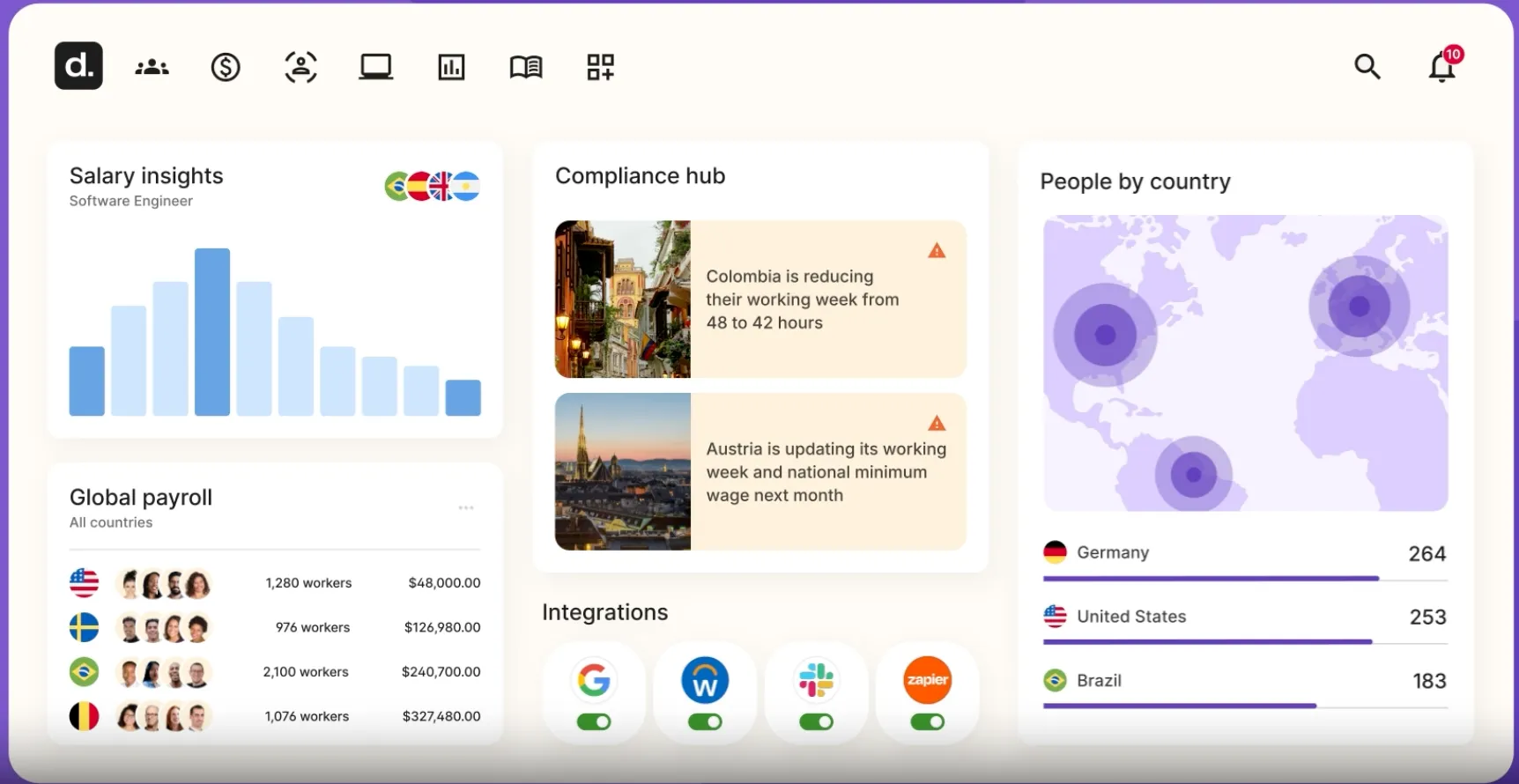
Deel’s all-in-one workforce platform helps HR teams onboard global hires quickly by automating localized contracts, compliance paperwork, and payroll setup. With its built-in HRIS and workflow automation, Deel centralizes employee records, task assignments, and approvals, while its global infrastructure reduces the friction of cross-border hiring. It also connects HR onboarding with IT device provisioning and app access so new employees can be productive on day one.
Key Features:
- Global Hiring and Onboarding Compliance – Generates localized contracts and automates country-specific tax and compliance forms during onboarding.
- Built-In HRIS for New Hire Setup – Centralizes worker profiles, documents, org charts, and onboarding/offboarding workflows in one system.
- Contractor and EOR Onboarding in 150+ Countries – Supports compliant onboarding for both contractors and full-time international employees without needing local entities.
- Automated Workflow Builder – Assigns onboarding tasks to HR, IT, managers, and new hires with approvals and reminders.
- Payroll and Benefits Integration – Syncs onboarding data directly into payroll runs, statutory benefits, and deductions globally.
- HR and IT Lifecycle Support – Coordinates device provisioning and tool access alongside HR onboarding for distributed teams.
- Analytics and Global Workforce Reporting – Tracks headcount, onboarding progress, compliance status, and time-to-productivity across countries.
18. Zoho People
Zoho People is a cloud-based HRIS with a dedicated onboarding module that helps teams automate and standardize preboarding and new-hire setup. Built for organizations that want a customizable, budget-friendly HR platform, Zoho People streamlines everything from offer acceptance to Day-1 readiness using workflows, checklists, document collection, and an employee self-service portal.
- G2 rating: 4.4 / 5
- Price: Free plan for up to 5 employees; paid plans start around $1.25–$1.50 per employee/month (billed annually), with higher tiers adding advanced workflows, performance, and analytics.
- Best for: Small to mid-sized businesses looking for an affordable, highly customizable HRIS with built-in onboarding.
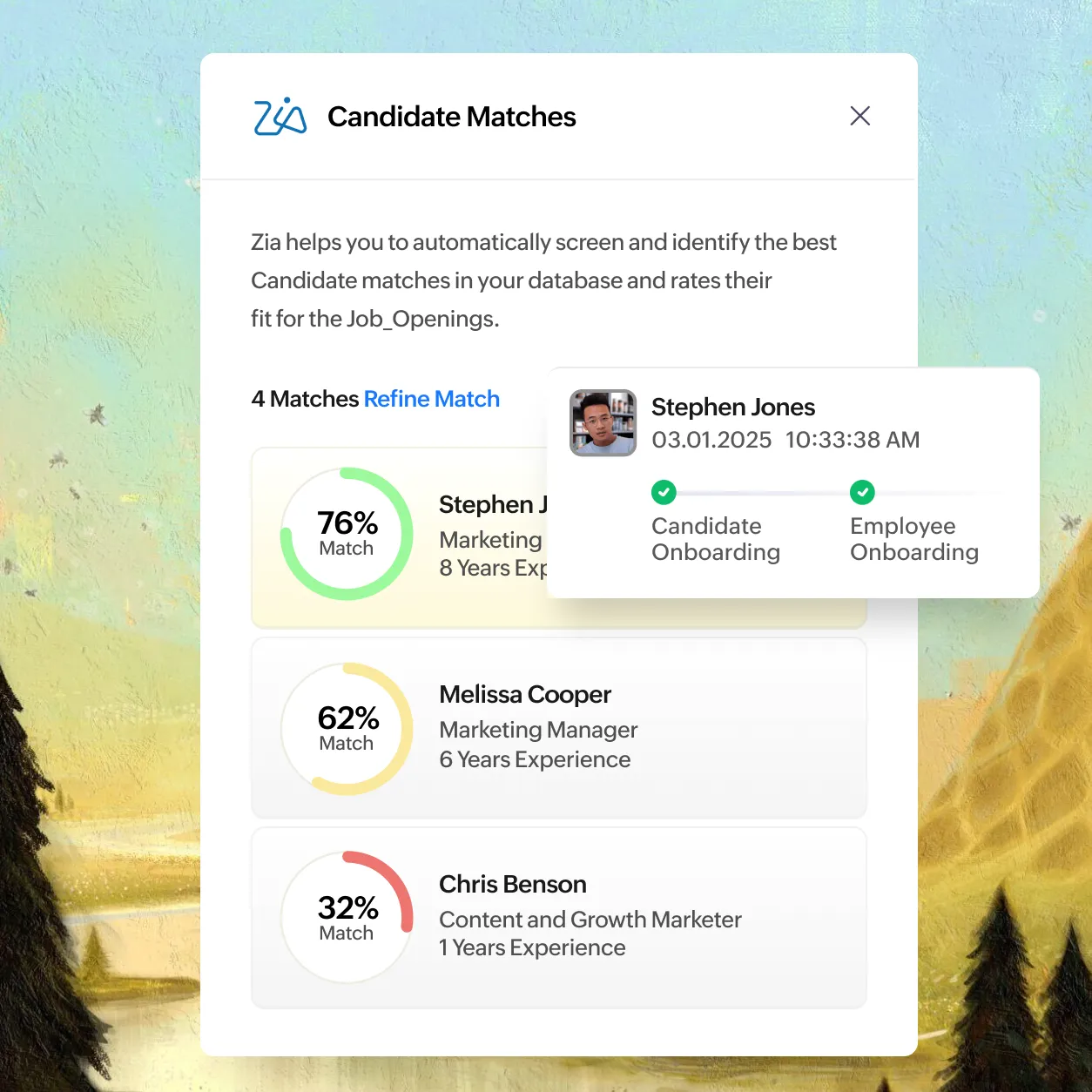
Zoho People’s onboarding tools make it easy to coordinate HR, IT, and manager tasks in one place. You can create structured onboarding flows, assign role-based tasks, collect and e-sign documents, and guide new hires through a branded portal. With strong customization and integrations across Zoho apps (and common third-party tools), Zoho People helps teams reduce manual admin while improving consistency and employee experience.
Key Features:
- Customizable Onboarding Flows and Checklists – Build step-by-step onboarding journeys tailored to roles, departments, or locations.
- New Hire Self-Service Portal – Lets employees complete forms, upload documents, review policies, and track onboarding progress.
- Automated Task Assignments and Approvals – Routes tasks to HR, IT, managers, and buddies with reminders and status tracking.
- Document Collection and E-Signature Support – Centralizes offer letters, tax forms, and policy acknowledgements with digital signing.
- Preboarding + Day-1 Readiness – Supports pre-start tasks (like paperwork and equipment requests) to reduce first-day friction.
- Integrations Across HR Stack – Connects onboarding data with time tracking, payroll, and other Zoho/third-party tools.
- Onboarding Reports and Analytics – Tracks completion rates, bottlenecks, and engagement to improve your process over time.
19. Namely
Namely is an all-in-one HCM platform for mid-sized companies that brings together core HR, payroll, benefits administration, time tracking, and a guided employee onboarding experience. Built with a modern, employee-friendly interface, Namely helps HR teams automate paperwork, coordinate cross-functional tasks, and deliver a consistent new-hire journey from preboarding through ramp-up.
- G2 rating: 3.9 / 5
- Price: Custom pricing based on company size and selected modules (core HR, onboarding, payroll, benefits, time, talent).
- Best for: Mid-sized, U.S.-based organizations that want a single HCM platform with payroll/benefits plus structured onboarding.
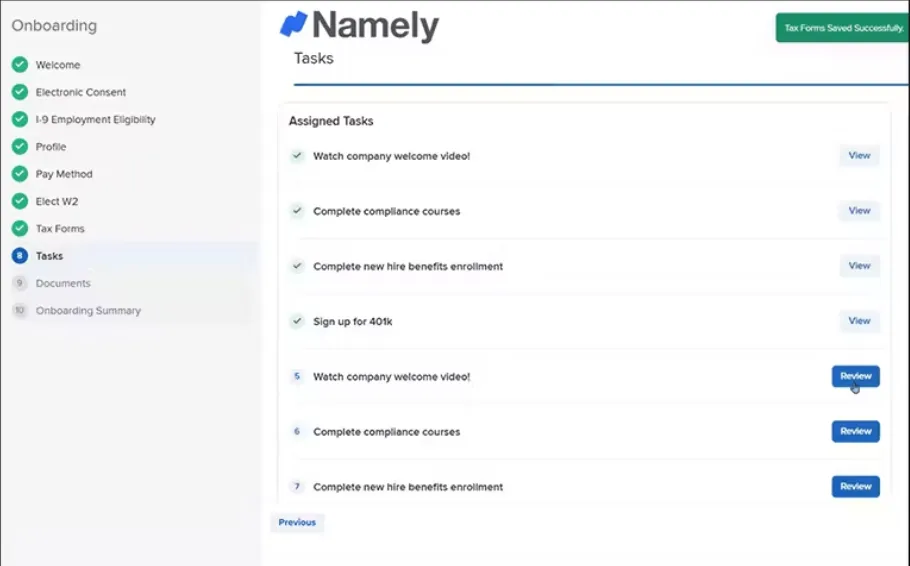
Namely’s onboarding tools are tightly connected to the rest of its HCM suite, which makes it easy to move a new hire from offer acceptance into HR setup, payroll enrollment, benefits eligibility, and day-one readiness. HR can assign tasks across teams, collect and store documents securely, and give new employees a self-service portal for completing forms, reviewing policies, and meeting key milestones.
Key Features:
- Guided Onboarding Workflows and Task Lists – Creates role-based onboarding plans and assigns tasks to HR, IT, managers, and new hires with reminders.
- New Hire Self-Service Portal – Lets employees complete paperwork, view policies, update profiles, and track onboarding progress.
- Paperwork Automation and E-Signatures – Centralizes offer letters and required forms with digital signing to speed completion.
- Integrated Payroll and Benefits Setup – Syncs onboarding data directly into payroll, benefits enrollment, and eligibility tracking.
- Compliance Support for U.S. Hiring – Helps manage required documentation and verification steps within the onboarding flow.
- Customizable Templates & Permissions – Tailors onboarding checklists and access by department, location, or role.
- Reporting and Onboarding Insights – Tracks completion status, bottlenecks, and new-hire engagement to improve time-to-productivity.
20. Justworks
Justworks is a PEO-powered HR, payroll, benefits, and onboarding platform designed to simplify the entire employee lifecycle for small and mid-sized businesses. It combines full-service payroll, benefits administration, compliance support, and structured onboarding workflows in one place—so teams can hire fast, stay compliant, and give new employees a smooth start.
- G2 rating: 4.6 / 5
- Price: Tiered per-employee pricing. Payroll plan starts around $8/employee/month (+ a monthly base fee). PEO plans typically start around $79/employee/month for Basic and about $109/employee/month for Plus (which adds richer benefits). Employer of Record (EOR) hiring for international employees is usually around $599/employee/month.
- Best for: U.S.-based small to mid-sized companies that want a PEO with built-in onboarding, payroll, and access to strong benefits.
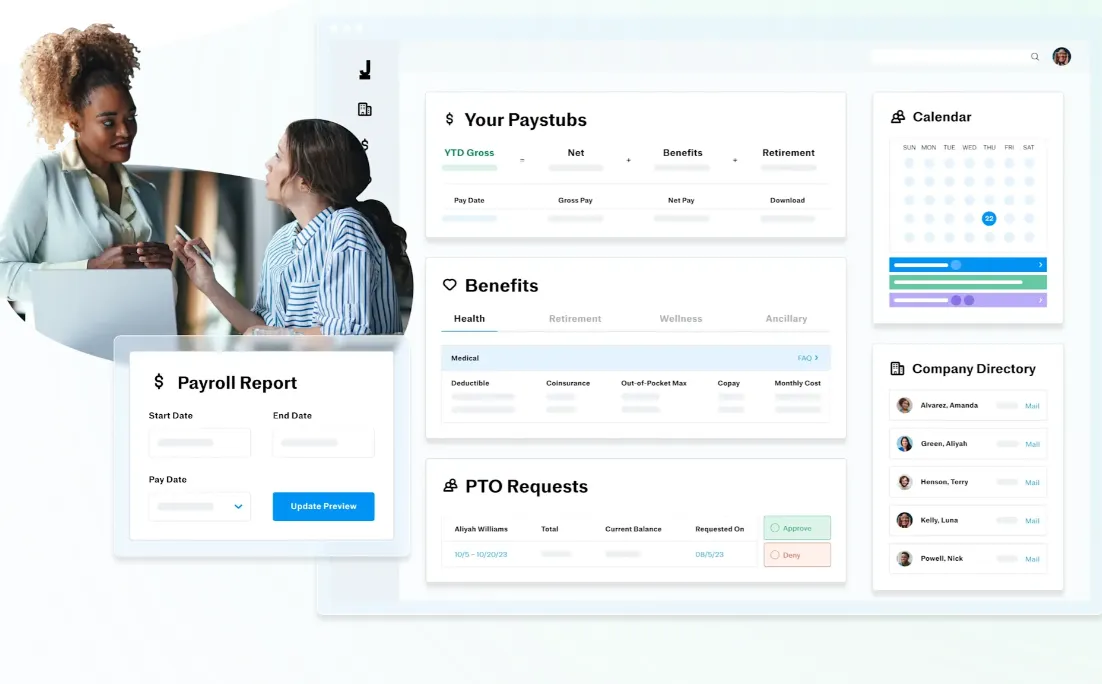
Justworks helps HR teams streamline onboarding by automating paperwork, assigning cross-functional tasks, and connecting new-hire setup directly to payroll and benefits enrollment. Because onboarding lives inside the same system as core HR and compliance, employee data flows automatically from offer to Day 1, reducing duplicate entry and minimizing costly errors. The platform also provides live HR support to help businesses navigate onboarding-related compliance and benefits questions.
Key Features:
- PEO-Backed Onboarding + Compliance – Supports new-hire setup with built-in HR compliance guidance, workers’ comp coverage, and tax handling.
- Automated Onboarding Workflows and Task Lists – Creates structured checklists and assigns tasks to HR, IT, managers, and new hires with reminders.
- New Hire Self-Service Portal – Lets employees complete forms, upload documents, review policies, and access pay/benefits info before Day 1.
- Payroll Setup and Tax Filing Automation – Syncs onboarding data into payroll runs, automates tax registrations, and handles W-2s and filings.
- Benefits Enrollment During Onboarding – Provides access to competitive health, dental, vision, and wellness benefits with simplified enrollment.
- Time Tracking and PTO Tools – Includes time tracking and leave policies that connect directly to payroll for day-one readiness.
- HR Support and Advisory Services – Offers expert support for onboarding questions, policy setup, and ongoing employee management.
How to Choose the Best Onboarding Software for Your Organization
Selecting the right employee onboarding software is a critical decision for IT and HR leaders. The right platform can streamline administrative tasks, improve employee engagement, and enhance security compliance, but choosing a solution that aligns with your organization’s needs requires careful consideration. From integration capabilities to user-friendliness and scalability, here are key factors to evaluate before making your decision.
- Assessing Organizational Needs
- Evaluating User-Friendliness
- Considering Integration Requirements
- Scalability and Customization Options
- Vendor Support and Training
- Cost-Benefit Analysis
Assessing Organizational Needs
Before investing in an employee onboarding management software, organizations must first identify their biggest HR challenges. Common pain points include:
- Time-consuming manual processes that slow down onboarding.
- Compliance risks due to inconsistent document tracking.
- Lack of employee engagement leading to higher turnover rates.
- Integration struggles with existing HR tools.
By conducting an internal audit, HR and IT leaders can determine which features are essential—whether it’s automated workflows, compliance tracking, or IT provisioning—and select a platform that directly addresses these challenges.
Evaluating User-Friendliness
Even the most feature-rich onboarding platform is ineffective if employees and HR teams struggle to use it. A user-friendly interface (UI) ensures:
- Faster adoption among HR teams and managers.
- A smooth onboarding experience for new hires.
- Reduced training time for HR and IT teams.
When evaluating software, look for intuitive dashboards, drag-and-drop workflows, and self-service portals that make onboarding effortless. Many vendors offer free trials or demos, which can help assess usability before committing to a purchase.
Considering Integration Requirements
A major factor in choosing onboarding software is its ability to integrate with existing HR and IT systems. The ideal solution should seamlessly connect with:
- HRIS platforms for employee records management.
- Payroll systems to automate tax and salary setup.
- Applicant tracking systems (ATS) for a smooth transition from candidate to employee.
Without proper integration capabilities, onboarding software can create information silos, forcing HR teams to enter data manually—leading to inefficiencies and errors.
Scalability and Customization Options
As companies grow, their onboarding needs evolve. A startup with 50 employees today might expand to 500 employees in a few years, requiring a scalable onboarding solution. When evaluating platforms, consider:
- Whether the software supports enterprise-level onboarding.
- Customizable workflows that can be adjusted for different departments and roles.
- Role-based access controls to accommodate expanding security needs.
Scalability ensures that HR teams won’t need to switch platforms as the company grows, saving time and money in the long run.
Vendor Support and Training
No matter how well-designed a platform is, strong vendor support is essential. Look for onboarding software providers that offer:
- 24/7 customer support via chat, phone, or email.
- Training materials and onboarding guides for HR teams.
- Dedicated account managers for personalized assistance.
A lack of vendor support can lead to delays in resolving issues, negatively impacting both HR teams and new hires.
Cost-Benefit Analysis
Pricing for employee onboarding software varies widely based on features, user count, and service level. When assessing cost, consider:
- Subscription-based vs. one-time licensing fees.
- Additional costs for integrations, user seats, or premium support.
- The potential ROI—such as reduced HR workload, improved compliance, and increased retention.
While low-cost solutions may seem appealing, an inexpensive platform that lacks essential features can lead to higher operational costs in the long run. Evaluating the total cost of ownership (TCO) ensures that businesses get the best value for their investment.
Choosing the right employee onboarding software requires a strategic approach that considers usability, integration capabilities, scalability, support, and cost-effectiveness. By carefully evaluating these factors, IT and HR leaders can ensure they select a solution that meets current needs while supporting future growth, ultimately enhancing new hire experiences and operational efficiency.
How to Implement Onboarding Software Successfully
Implementing onboarding software isn’t just a technical rollout; it’s a change to how your company welcomes, equips, and ramps new hires. The goal is to move from a manual, inconsistent process to a repeatable experience that’s easy for HR to manage and easy for employees to complete.
The most successful launches follow a phased approach: test with a small group, migrate data carefully, train every role involved, and track outcomes so you can keep improving. Below are the four steps to get right from the start:
- Pilot Group
- Data Migration
- Stakeholder Training
- Success Metrics
Pilot Group
Rolling out onboarding software to everyone at once can create chaos, even with a great tool. Start with a pilot group that lets you test your workflows in a low-risk environment. Pick a representative slice of hiring scenarios: one department that hires frequently, a mix of remote and in-office roles, and at least one manager who’s excited to help improve the process.
Run the pilot for a defined window (often 4-8 weeks or a set number of hires). During this phase, validate your checklists, automation rules, document flows, and integrations. Encourage new hires, managers, HR, and IT to flag friction points immediately and expect to tweak: pilots are about learning fast, not proving perfection. Once the group is consistently onboarding without manual workarounds, you’re ready to expand.
Data Migration
Clean data is the difference between “launch day” and “fire drill day.” Before migrating anything, decide what truly needs to move into the new platform. Most teams migrate core employee fields, standard onboarding templates, policy documents, and open onboarding tasks.
Archive old forms and duplicates so they don’t pollute the new system and map each field from your current HRIS or spreadsheets to the new tool’s structure, and confirm ownership (for example, who maintains job titles, departments, start dates, or location codes). Run a small test migration first, then spot-check results for completeness and accuracy. Pay special attention to permissions and sensitive documents: contracts, IDs, tax forms, and background checks must land in the right security groups. If your tool integrates with payroll or IT provisioning, validate end-to-end flows before go-live.
Stakeholder Training
Even the best onboarding software fails without adoption. Train stakeholders based on what they actually do, not everything the tool can do:
- HR needs deeper training on workflow setup, template editing, and troubleshooting.
- Managers need a simple, task-based view: how to approve steps, assign buddies, and track progress.
- IT and Facilities should learn how provisioning requests arrive, what “done” looks like, and where handoffs happen.
- New hires only need a clean portal walkthrough and clear expectations for deadlines.
Use short role-specific sessions, recorded demos, and quick reference guides. Most importantly, explain the “why”: fewer manual follow-ups, better Day-1 readiness, and clearer accountability. Finally, identify a few internal champions to answer questions and sustain momentum after launch.
Success Metrics
Define success before rollout so you can measure real impact. Start with operational metrics such as time to complete preboarding, percentage of tasks finished by Day 1, and reduction in HR follow-ups. Then add experience metrics like new-hire satisfaction, manager satisfaction, and portal completion rates. For business outcomes, track 30/90/180-day retention, time-to-productivity, and compliance completion rates.
You should also set baselines using your old process so improvements are visible. Review metrics weekly during the pilot, then monthly post-launch, and use results to refine templates, remove bottlenecks, and add automation where it matters most. When outcomes are measurable and trending up, the software isn’t just implemented; it’s delivering value.
Future Trends in Employee Onboarding Software
As technology evolves, so does the way organizations approach employee onboarding. The future of onboarding software is shifting toward automation, personalization, and predictive analytics, helping HR teams create seamless, engaging, and data-driven onboarding experiences. Below are the key trends shaping the future of employee onboarding software and how they will impact IT and HR leaders.
Artificial Intelligence and Machine Learning Integration
AI and machine learning (ML) are revolutionizing employee onboarding automation by reducing manual workload, personalizing experiences, and enhancing decision-making for HR teams. AI-powered onboarding solutions can:
- Automate task assignments based on job roles and department needs.
- Use chatbots to answer common HR questions, reducing dependence on HR personnel.
- Analyze hiring patterns to improve onboarding workflows over time.
Machine learning algorithms can also identify trends in new hire success, helping companies refine onboarding strategies and improve retention rates. As AI continues to evolve, expect more intelligent, adaptive onboarding experiences that require minimal manual intervention from HR teams.
Enhanced Mobile Onboarding Experiences
With remote work and hybrid workplaces becoming the norm, mobile-first onboarding experiences are gaining traction. Organizations are increasingly adopting mobile-friendly onboarding software to:
- Allow employees to complete forms, training, and HR tasks on their smartphones.
- Enable e-signature functionality for remote paperwork submission.
- Provide mobile chat support for quick access to HR assistance.
Mobile-optimized onboarding tools ensure that new hires can onboard from anywhere, making it easier for global and distributed teams to feel connected and engaged from day one.
Personalization and Employee-Centric Approaches
A one-size-fits-all onboarding approach is becoming obsolete. Companies are now shifting toward personalized, employee-centric onboarding experiences, ensuring that each new hire receives a tailored journey based on:
- Their role and department (customized training modules, workflows).
- Personal learning preferences (self-paced vs. instructor-led training).
- Company culture engagement (introductions to team members with similar interests).
By leveraging customizable onboarding workflows, organizations can improve employee engagement, productivity, and long-term retention.
Advanced Analytics for Predictive Insights
HR teams are increasingly leveraging analytics to gain deeper insights into onboarding effectiveness. Advanced analytics tools provide:
- Real-time tracking of onboarding completion rates.
- Predictive analytics to identify which onboarding strategies lead to higher retention.
- Employee sentiment analysis based on survey feedback.
With data-driven insights, HR leaders can continuously refine their onboarding process, ensuring that it remains efficient and aligned with organizational goals.
The future of employee onboarding software is defined by automation, mobile accessibility, personalization, and predictive analytics. As organizations invest in AI-driven tools and mobile-first platforms, onboarding will become more efficient, engaging, and tailored to each employee's needs. IT and HR leaders who embrace these trends will create seamless onboarding experiences that drive long-term employee success and retention.
Simplify Employee Onboarding with Lumos
Selecting the right employee onboarding software is essential for organizations looking to streamline HR workflows, enhance compliance, and create a seamless new hire experience. From automated workflows and document management to integration capabilities and mobile accessibility, the best onboarding platforms enable HR teams to reduce administrative burdens while improving employee engagement and retention.
Lumos goes beyond traditional onboarding solutions by offering a fully automated, secure, and scalable approach to employee access provisioning and access management. With comprehensive visibility, intelligent workflow automation and seamless integrations, Lumos ensures that new hires have the right tools, access, and resources from day one, eliminating bottlenecks and reducing security risks.
Lumos simplifies onboarding by:
- Automating IT systems and applications access provisioning based on role-specific policies.
- Integrating with HRIS, IdP, payroll, and SaaS applications for a seamless onboarding experience.
- Providing real-time visibility into employee permissions and access levels to ensure compliance.
- Eliminating security vulnerabilities and risks with least-privilege access and automated lifecycle management .
By leveraging Lumos’ onboarding automation capabilities, IT and HR teams can reduce manual workload, accelerate onboarding timelines, and enhance security compliance—all while creating a frictionless experience for new hires.
Ready to revolutionize your employee onboarding process? Book a demo with Lumos today and discover how automation and security-first onboarding can transform your organization.
Employee onboarding software FAQs
How long does onboarding take?
Onboarding isn’t a single moment: it’s a process. Most companies think in two phases: preboarding (from offer acceptance to Day 1) and ramp-up onboarding (first 30–90 days). Preboarding often takes 1–2 weeks depending on paperwork and provisioning. The structured onboarding experience usually spans 30, 60, or 90 days, with role-specific milestones along the way. Onboarding software helps shorten timelines by automating tasks and ensuring nothing slips through the cracks, but the right length depends on role complexity and your training needs.
Do small teams need dedicated software?
Not always, but many small teams benefit sooner than they expect. If you hire only a few people a year and your process is simple, a lightweight tool or HRIS onboarding module might be enough. But once you’re juggling multiple stakeholders (HR, managers, IT), remote hires, compliance forms, or repeatable training, software quickly pays off. The big win for small teams is consistency without extra admin – you get structured checklists, automated reminders, and a better new-hire experience without adding headcount.
What integrations matter most?
The most valuable integrations are the ones that remove manual handoffs. Prioritize:
- HRIS / employee directory to sync employee data automatically
- Payroll and benefits so new hires are set up for pay and enrollment on time
- IT provisioning / identity tools (like device requests, SSO, app access, ticketing) for Day-1 readiness
- Learning or training systems (LMS) if training is a big part of ramp-up
- Communication tools (email, Slack/Teams) for automated nudges and updates
The right stack depends on your workflow, but the rule is simple: integrate where you currently copy/paste or chase people.
How does onboarding software improve retention?
Great onboarding reduces early uncertainty and helps employees feel productive faster.
Software supports retention by:
- Making the first days feel organized and welcoming
- Ensuring managers are consistent and accountable
- Clarifying expectations, goals, and timelines
- Removing delays in access, equipment, and paperwork
- Tracking engagement so HR can intervene early
When employees start smoothly, they’re more likely to build confidence, relationships, and long-term commitment.
What’s the difference between preboarding and onboarding?
Preboarding happens before Day 1. It focuses on readiness: paperwork, contract signing, background checks, equipment requests, account setup, and sharing key info so the new hire walks in prepared.
Onboarding begins on Day 1 and continues through ramp-up. It covers role training, cultural integration, performance expectations, relationship building, and progress milestones.
Good software supports both: preboarding for compliance and logistics, onboarding for productivity and engagement.





Don't let any identity become your next breach.
Govern every human, machine, and AI in your business with a free identity assessment today.
Book a Demo
The autonomous identity platform. Agents that continuously govern access for every human, machine, and AI.