
Identity Governance vs Identity Management (IGA vs IAM): 8 Key Differences
May 12, 2026
Treating IAM and IGA as the same thing creates real gaps in your security posture. Learn 8 key differences between identity governance and identity management.

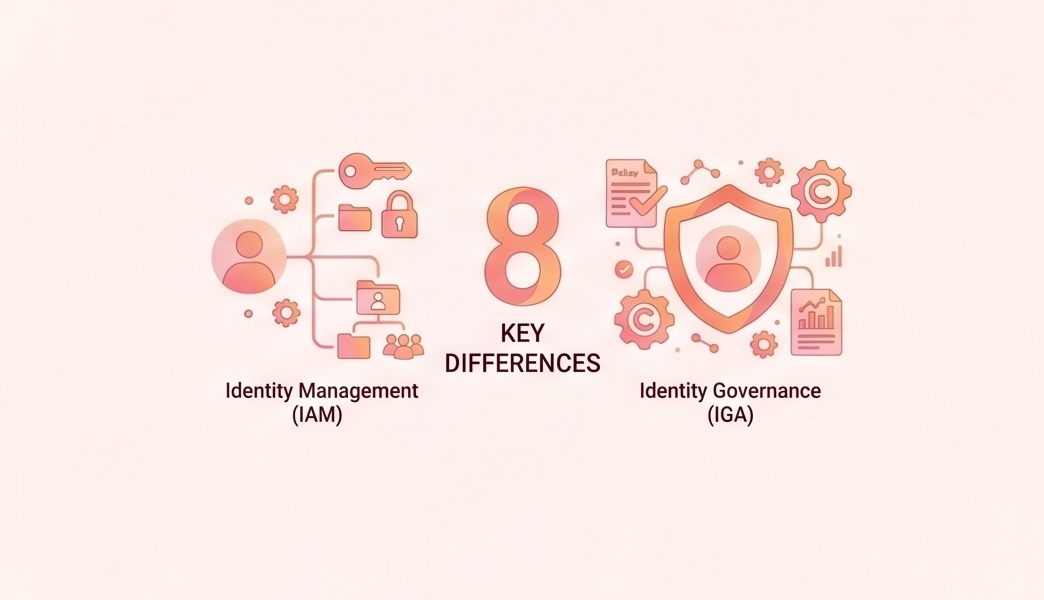
You deployed SSO across the company. You turned on MFA. You even integrated your identity provider with most of your SaaS apps. And when the auditor asked "who has access to what," you still couldn't answer the question without pulling four spreadsheets and chasing down three managers who hadn't reviewed anything in months.
That gap between "we control access" and "we can prove access is appropriate" is the gap between IAM and IGA. Most teams blur the line between these two disciplines, and it costs them in audit prep time, overprovisioned accounts, and security exposure they don't even know they're carrying.
They show up in almost every security strategy conversation and they're often used interchangeably. That makes sense on the surface since both deal with managing user identities and permissions. But they're not the same thing, and treating them as if they are creates real gaps in your security posture.
They work best together, but each serves a distinct purpose. This article breaks down the key differences between identity governance and identity management so you can see where each one fits and where your gaps are worth closing.
1. Scope of Responsibility
IAM answers one question. "Can this person get in?" It handles authentication, verifying that someone is who they claim to be through passwords, MFA, and biometrics. It handles authorization, granting the right level of access at the moment of login. It runs your SSO, manages your directory, and enforces session policies. When IAM is working well, the right people get into the right apps without friction. That's the job.
IGA answers a completely different question. "Should this person have this access, and can we prove it?" IGA sits on top of IAM and adds the governance layer. It covers the policies, processes, and administrative controls that make sure all those access decisions actually align with your compliance requirements and security posture. It doesn't just care about the login event. It cares about the full identity lifecycle, from the day someone joins to the day they leave, and every role change in between.
The scope difference matters more than most teams realize. IAM has a narrow focus. It provisions access and maintains the identity directory. IGA covers the entire identity lifecycle. It enforces least privilege, manages separation of duties, runs access reviews, and produces the evidence your auditors need. Increasingly, that lifecycle extends beyond people. Service accounts, API keys, and AI agent credentials need the same lifecycle oversight — joined when created, reviewed while active, and decommissioned when no longer needed — even though none of them appear in your HR system. In practice, IAM is a component that lives inside a broader IGA strategy. Treating it as the whole strategy is where things break down.
Here's the simplest way to think about it. IAM is the doorman checking IDs. IGA is the security manager who decides the guest list, reviews the entry logs, and flags anyone who's been hanging around too long without a reason. A lot of teams deploy an identity provider and assume governance is handled. It's not. Without IGA processes layered on top, you have access control with no oversight.
2. Primary Focus and Objectives
IAM optimizes for speed and productivity. Its job is to make sure you can get people into the apps they need without creating bottlenecks. Self-service password resets, single sign-on, federated authentication. These features exist because IAM is built to reduce friction at the moment of access. When your IAM is working, nobody's waiting around for a login to go through.
IGA optimizes for risk reduction and compliance over time. It's less concerned with the login experience and more concerned with whether every access decision is justified, documented, and reviewed on a regular cadence. IGA enforces least privilege. It tracks entitlements. It produces the audit trail that proves you're actually following the policies you wrote down. Where IAM asks "can Alice get into App X right now," IGA asks "should Alice have access to App X at all, who approved it, and when was it last reviewed."
This creates a natural tension between short term and long term thinking. IAM is transactional. It's measured by login success rates, provisioning speed, and helpdesk ticket deflection. IGA is strategic. It's measured by risk posture, audit findings, and whether privilege creep is actually getting caught before it becomes a problem. Both protect data, but through completely different lenses.
IAM keeps unauthorized users out in the moment. IGA continuously verifies that even authorized users still deserve the access they have. If IAM is the engine that drives access, IGA is the guardrails that keep the engine pointed in the right direction. You need the engine to move. You need the guardrails to not drive off a cliff.
3. Core Capabilities
On the IAM side, the functions are straightforward. Authentication verifies identity through passwords, MFA, or biometrics. Access control enforcement checks permissions at login or when a user hits a resource. SSO and MFA centralize access across applications. Directory services like Active Directory or a cloud identity provider store user accounts in one place. IAM answers the immediate question of "is this user allowed to log in right now" and its tools are built to respond to that in real time.
IGA builds on top of that by adding oversight and lifecycle management. User provisioning and deprovisioning automate account creation when someone joins and account removal when they leave, the joiner-mover-leaver workflows that most teams still run manually. Access reviews and certifications periodically check who has access to what, with managers certifying or revoking permissions on a set cadence. Role-based access control defines roles with appropriate permissions to standardize access. Segregation of duties enforcement ensures no single user holds a dangerous combination of permissions, like being able to both request and approve their own access to sensitive data. And audit logging generates the reports you need to prove compliance when the auditor shows up.
The difference shows up clearly when you walk through a real scenario. A new employee joins. IAM creates their account and lets them log in to the required apps. IGA auto-assigns the correct entitlements based on that employee's role, then three months later prompts their manager to review whether those permissions are still appropriate. Both are involved in the same hire, but they're doing fundamentally different work.
The same logic applies to non-human identities, with one important difference: there's no HR event to trigger the workflow. When a developer creates a service account directly inside AWS, neither IAM nor IGA knows it exists unless the platform actively discovers it. Modern IGA extends its core capabilities (discovery, ownership assignment, access reviews, and decommissioning) to machine identities, not just human ones
This is where most teams feel the friction of running IAM and IGA as separate tools. The provisioning event lives in one platform. The review and certification lives in another. The audit trail is stitched together from both. Lumos collapses that gap by handling access provisioning and governance in a single platform, so the joiner-mover-leaver workflow and the access review that validates it share the same data, the same policies, and the same audit log.
4. Timeframe of Control
IAM operates at the moment of access. When Bob tries to sign into the corporate VPN, the IAM platform confirms his identity via SSO and MFA and decides right then whether he can get in. Once access is granted, IAM's job is done until the next login event. It's transactional by nature, focused entirely on the real time authentication and authorization decision.
IGA is concerned with what happens before and after those login events. It manages the entire lifecycle of an identity, from the day a user is onboarded through role changes and promotions to eventual offboarding. IGA doesn't set someone up and forget about them. It continues to govern access on an ongoing basis through quarterly access certifications, continuous monitoring for privilege creep, and policy enforcement that adapts as roles shift. The question IGA keeps asking is "should this user still have this access."
That concept of privilege creep is worth sitting with. Over time, users gradually accumulate more access than they need as they move between roles or stay at the company long enough to collect permissions like souvenirs. IAM alone won't catch this. If a user's access is no longer appropriate, IAM will still let them in until someone manually updates or removes it. Without IGA, your identity provider becomes a mechanism for accumulating access. Orphaned accounts, created for a project, never tied to an offboarding workflow, and still active years after anyone last needed them, linger after employees leave. Segregation of duties violations go undetected. Nobody notices until the auditor does.
Here's what the lifecycle looks like in practice. On day one, IAM provisions John's accounts and lets him log in. Over his first year, IGA triggers two access reviews to confirm he only has what he needs. When John switches departments, an IGA workflow adjusts his roles and permissions accordingly. When John leaves, IGA ensures all his access is revoked immediately. IAM shows up at the moment of login. IGA is present throughout the entire journey. Platforms like Lumos handle both sides of this timeline in one place, so the provisioning event on day one and the access review six months later share the same data and the same policy engine.
5. Governance (Policy Oversight) vs Operational Execution
IAM plays an operational role. It executes the day to day tasks of identity management and access control. It checks a user's group membership before allowing access to a resource. It verifies credentials against the directory. It enforces password policies and session timeouts. This is IT operations work, keeping the gears of access turning so nobody gets blocked from doing their job. IAM success means users rarely get stuck waiting for access.
IGA plays a governance role. It sets the rules and makes sure the IAM engine follows them. It defines who should have access to what through governance policies like least privilege and role-based access rules, and it monitors compliance with those policies over time. IGA connects access management to broader governance needs like audit requirements and regulatory mandates. It's not doing the login checks. It's making sure those login checks and all the provisioning behind them follow your policies and produce evidence for auditors.
It's a checks and balances model. IAM says "yes, you may enter" or "no, you're not allowed." IGA checks after the fact and asks "did we allow the right person to enter, and do they still need to be here." If something is out of line with policy, IGA triggers a revocation or adjustment. IAM is about doing things right. IGA is about doing the right things.
This distinction also shows up in who's involved. IGA brings compliance officers and security governance teams into the decision-making process. It bridges IT and compliance. IAM is typically handled by IT help desks and admins as part of daily operations. Strong IAM without governance gives you fast access but no oversight. Governance without IAM gives you good policies but no enforcement engine. The problem is that most teams run these as separate workstreams with separate tools, which means the policies defined in IGA and the access decisions executed in IAM don't share context. That disconnect is exactly what creates rubber-stamp reviews and undetected violations.
6. Ownership and accountability
IAM is typically owned by IT operations or identity management teams. Their priorities center on uptime, provisioning speed, and user productivity. Their KPIs look like login success rates, helpdesk ticket reduction, and how fast a new hire gets access on day one. From the IT ops perspective, success means users rarely get blocked from doing their jobs. High availability and ease of access are what matter most.
IGA initiatives are usually driven by security teams or GRC teams. Their concerns look quite different. They care about passing audits, mitigating access risks, and enforcing policies like least privilege and regulatory mandates like SOX and HIPAA. Their KPIs revolve around risk metrics, audit findings, compliance reports, and closure of access governance tasks. Where IAM measures success by availability, IGA measures success by risk reduction and complete audit trails.
These teams have to collaborate even though they own different parts of the problem. If the security team sets a policy via IGA that no contractor should have admin rights to finance apps, the IT team needs to implement and enforce that through IAM tooling. Without cooperation, gaps open up fast. The governance program led by InfoSec or GRC defines what needs to happen. The IAM administrators in IT execute on how it happens.
This split in ownership is also where tool sprawl compounds the problem. When the GRC team runs access reviews in one platform and the IT team provisions access in another, neither side has full context. The reviewer approving access doesn't see real time usage data. The admin provisioning access doesn't see the policy constraints. Lumos eliminates that gap by giving both teams a shared platform where governance policies, provisioning workflows, and review campaigns all operate on the same data. The security team sets the rules. The IT team executes them. And both work from one source of truth instead of reconciling spreadsheets after the fact.
7. Audit readiness
One of the biggest drivers for IGA is regulatory compliance. IAM by itself is not sufficient to meet audit requirements. Your SSO platform or directory can tell you who currently has access to a given app and can enforce password policies. But it can't demonstrate that those access rights were reviewed on a set cadence, approved by the right manager, or aligned with least privilege. You can have perfectly secure logins and still fail an audit because you can't produce the evidence.
IGA exists in large part because regulations like SOX, HIPAA, and GDPR demand strict control and documentation of who can access sensitive data. IGA maintains audit trails of access grants and removals, records manager approvals, and conducts regular access certifications where reviewers verify that permissions are still appropriate. That's the kind of evidence an auditor expects to see. Not just that access is controlled, but that it's governed, documented, and reviewed on a repeatable schedule.
The risks of skipping IGA here are concrete. Overprovisioned accounts, rubber-stamp approvals, and lack of visibility lead directly to audit failures, regulatory penalties, and security gaps you won't catch until it's too late. Under SOX, for example, you need to ensure that no single individual has end to end control over financial transactions. That's a segregation of duties control. An IAM tool can enforce roles at login, but an IGA platform will flag conflicting entitlements, require additional approval, and log those controls so you can show auditors that no violations went unaddressed.
This is where the manual approach falls apart at scale. Running access reviews across spreadsheets, chasing managers for sign-offs, and stitching together audit reports from multiple tools turns every review cycle into a multi-week project. Pluralsight experienced this firsthand. Before Lumos, they reviewed 20 apps over two months every quarter. After deploying Lumos, they review 200 apps in under two weeks. That's not an incremental improvement. It's the difference between dreading audit season and treating it as routine.
8. Coverage across apps
IAM tools like identity providers typically manage access for apps that integrate via standard protocols like SAML, OIDC, or LDAP. That covers many cloud apps and corporate tools, but not everything. Your IAM might authenticate users for the company VPN, email, and HR platform. But it likely lacks visibility into granular entitlements inside those apps, like what specific data or functions a user has within Snowflake or AWS. And standalone legacy apps or databases that aren't tied into SSO become blind spots entirely.
IGA is meant to gather and correlate identity and access data from everywhere. It acts as an aggregator of accounts and permissions across disparate apps, including those that IAM doesn't directly control. An IGA tool can import a user list from a legacy mainframe app or a database so those accounts are also reviewed and governed. IAM is often limited to apps that support federation standards. IGA needs to cover the entire IT environment, including on-prem legacy apps, disjointed SaaS tools, and unstructured data.
The difference in granularity is significant. IAM might only control coarse access, determining whether you can log into Salesforce at all. IGA governs what permissions within Salesforce you should have and ensures those permissions are reviewed. It answers not just "can Alice access Salesforce" but "what can Alice do in Salesforce, and is that appropriate for her current role."
IGA is also where you catch things that fall outside the normal IAM view: shadow IT accounts that users create in external services without IT's knowledge; orphaned accounts that remain active after an employee leaves; and non-human identities created outside the IAM layer entirely, like service accounts provisioned directly in cloud platforms, API keys hardcoded into pipelines, or AI agents spinning up credentials on demand. These identities don't authenticate through SSO, so IAM never sees them. IGA, through periodic cross-checks with HR records, active discovery scans, and ownership mapping, is the only governance layer that can identify and remediate these gaps. Lumos takes this further with the industry's largest turnkey integration library, connecting to over 100 apps in under three months as Chargepoint demonstrated, and providing fine-grained visibility into permissions and usage data across SaaS, cloud, and on-prem environments. That's the difference between governing the apps your IdP knows about and governing every app your people actually use.
Why the difference between IGA and IAM matters
IAM and IGA are complementary disciplines, each with its own role. IAM provides the tools to securely provision and manage access in real time, ensuring users can get to what they need. IGA provides the oversight and control to ensure all those access privileges remain appropriate, compliant, and aligned with least privilege over time. One is the engine. The other is the steering and the brakes.
The problem is that most teams have been forced to stitch these together with separate vendors, separate data models, and separate workflows. The IAM tool handles provisioning. A different IGA tool handles reviews. A spreadsheet fills in the gaps between them. And every audit cycle becomes a reconciliation exercise instead of a governance exercise.
Lumos was built to eliminate that split. It brings access management and governance together in one autonomous identity platform, so provisioning, lifecycle automation, access reviews, and policy enforcement all share the same data and the same policy engine, covering human and non-human identities alike, with documented ownership for every credential in your environment. Joiner-mover-leaver workflows feed directly into review campaigns. Delta access reviews show reviewers only what changed since the last cycle instead of dumping every entitlement on their desk. AI-generated policies adapt as your workforce and app portfolio shift, without requiring your team to manually rewrite RBAC rules every quarter.
The results speak for themselves. Roku reduced onboarding time by 99%. Pluralsight went from reviewing 20 apps over two months to 200 apps in under two weeks. Nubank saved $2.7M in software spend while identifying hundreds of incompletely offboarded users. These aren't theoretical gains. They're what happens when access management and governance finally run on the same platform.
If you're running IAM and IGA as separate workstreams with separate tools, you're carrying gaps that show up as audit findings, overprovisioned accounts, and manual work that never scales. Book a demo with Lumos and see what happens when both sides of the equation share one platform.
See how our autonomous identity governance works
Request a demo to see how Lumos can help you automate access reviews, enforce least privilege, and streamline identity lifecycle management across your organization.






Don't let any identity become your next breach.
Govern every human, machine, and AI in your business with a free identity assessment today.
Book a Demo
The autonomous identity platform. Agents that continuously govern access for every human, machine, and AI.