
Monitor and Remediate with Identity Security Agents
Identity risk moves fast, remediation has to move faster. Identity Security Agents monitor your environment continuously, surface findings the moment they appear, and fix them at scale, with you setting the level of autonomy. Humans design the system, agents do the work.

Trusted by the world's most innovative companies














The New Operating Model for Identity Security
Risk builds faster than human-led identity programs can operate, while dormant access, privilege creep, and unowned NHIs pile up between review cycles. Identity Security Agents change the model. They work continuously alongside your team to find risk, prioritize it and drive remediation, closing the gap between “we found it” and “it's fixed.”

Work that never stops
Agents monitor your identity environment continuously, not just during scheduled campaigns. They catch new risks as they emerge, to improve your posture in real time instead of at quarterly check-ins.

Single-session calibration
Tell an agent what to do in plain language, review its first output, and refine with feedback. It carries your exceptions and priorities forward from there without config files or a rules engine to maintain.

Remediation that sticks
Because agents run on Lumos's full IGA platform, a fix can become governance policy rather than a one-time patch, so the same risk doesn't come back next quarter.
How Identity Security Agents Work

Specific workflows
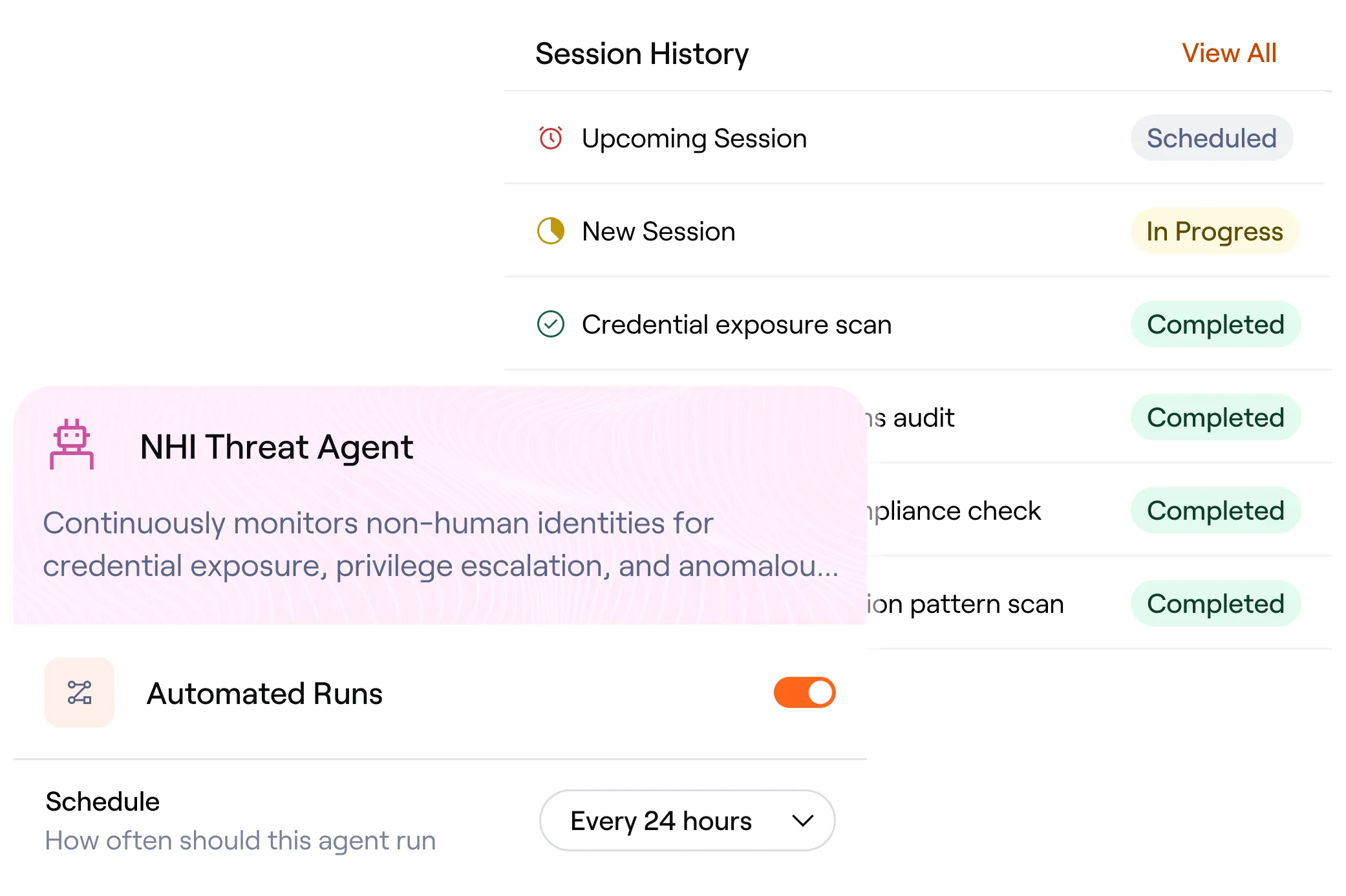
Each agent targets one class of identity risk: dormant access, SoD conflicts, privilege sprawl, or unowned NHIs.

Powered by context & memory
Tell an agent what to do in plain language once; it learns your environment's exceptions and priorities in that same session.

Built on deep visibility
Agents act on Lumos's full IGA platform, so a fix becomes governance policy, not a one-time patch.
Purpose-Built Agents for Identity Security
A distinct set of agents focused on finding and fixing security risk, not the full governance roster. For agents that run reviews, requests, and role mining across the identity lifecycle, see Identity Agent Force.

Dormant Access Agent
Finds accounts and entitlements that exceed your inactivity threshold and removes them or routes unclear cases for review.

SoD Investigation Agent
Cross-references entitlements against your Segregation of Duties policies, flags conflicts, and surfaces the evidence to resolve them.

Privilege Cleanup Agent
Identifies over-provisioned and privileged access that no longer matches a user's role and right-sizes it automatically within prebuilt guardrails.

NHI Ownership Agent
Monitors service accounts, API keys, and workload identities for missing owners or stale credentials and assigns or escalates ownership before it becomes a blind spot.
Identity Security Agents in Action
Specific workflows
Each agent targets one class of identity risk: dormant access, SoD conflicts, privilege sprawl, or unowned NHIs.


Natural language job assignment
Tell agents what to do in plain English. Describe the job, review the output, give feedback. Agents learn your environment's priorities and exceptions in a single session. No config files. No complex rules engines.
Turn findings into governance, not just fixes
Because the Lumos platform is a full IGA solution, agents aren’t limited to remediation, they can translate security findings into durable governance policy. Point-in-time fixes can become programmatic rules that prevent the same issue from recurring.













Additional Resources
Why Identity Needs Intelligence, Not Just Visibility
Why visibility alone isn't enough, what intelligence means for identity, and how to think about AI features versus agents that act.

Identity Is at a Breaking Point
Manual identity governance can't keep up with rising machine identities and evolving attacks. Why 2026 marks a turning point.
Frequently Asked Questions

Identity security agents are AI agents that continuously monitor an identity environment for specific security risks: dormant access, privilege creep, SoD conflicts, unowned non-human identities, and remediate them automatically within guardrails a human sets. Lumos's Identity Security Agents run this way, closing the gap between finding a risk and fixing it.
Albus is Lumos's AI identity agent for governance workflows like role design, reviews, and investigations. The Identity Agent Force is the broader roster of agents across the full identity lifecycle. Identity Security Agents is narrower by design: agents purpose-built for continuous security monitoring and remediation. They can draw on the same underlying access graph, but each is scoped to a different job.
That's your call. Start with full oversight, where agents surface findings for review before anything executes, and delegate broader remediation as confidence grows. Every dismissed finding is logged and informs the agent going forward.
Agents can be calibrated in a single session. Assign a job in plain language, review the first round of output, and give feedback. The agent carries your environment's priorities and exceptions forward from there.

Don't let any identity become your next breach.
Govern every human, machine, and AI in your business with a free identity assessment today.
Book a Demo
The autonomous identity platform. Agents that continuously govern access for every human, machine, and AI.