
Security Assertion Markup Language: What is SAML and How Does it Work?
Learn what Security Assertion Markup Language (SAML) is, how it works, and why it’s essential for single sign-on (SSO) and identity management. Explore SAML architecture, components, benefits, and its role in modern access security.

Security Assertion Markup Language (SAML) is a standards-based protocol that enables secure authentication and assertion of identity across security domains. It plays a pivotal role in enabling Single Sign-On (SSO) in enterprise environments, reducing password fatigue and centralizing identity management.
In an era where identity-related attacks are growing more sophisticated, the integrity and configuration of SAML workflows have real consequences. For example, Microsoft reports it has detected and blocked over 7,000 password attacks per second, highlighting the volume of credential-based threats that systems must resist. Misconfigured SAML implementations or weaknesses in assertion flows can be exploited by adversaries to impersonate users, bypass authentication, or escalate privileges.
In this article, you’ll discover how SAML works under the hood: its components, bindings, protocols, and profiles. We’ll explore how security is woven into SAML’s design (and where it can break down), and walk through challenges, and best practices.
What is Security Assertion Markup Language (SAML)?
Security Assertion Markup Language (SAML) is an open standard designed to simplify and secure the exchange of authentication and authorization data between identity providers (IdPs) and service providers (SPs). In essence, SAML eliminates the need for users to maintain separate credentials across multiple applications: by enabling a trusted exchange of identity assertions, it powers Single Sign-On (SSO) across enterprise and cloud services.
At its core, SAML addresses one of the most persistent challenges in enterprise IT: fragmented identity management. Without it, users must log in individually to each system or application, increasing both friction and risk. With SAML, authentication occurs once through the identity provider, and that verified session is extended securely to other connected systems. This not only streamlines user experience but also centralizes access control and monitoring for security teams.
SAML is built on Extensible Markup Language (XML), which structures identity data in a standardized, machine-readable format. This makes it interoperable across different platforms, vendors, and programming environments. SAML messages, known as assertions, carry user authentication and attribute information that the service provider uses to make authorization decisions. These assertions are digitally signed and exchanged through secure protocols, typically over HTTPS, to ensure integrity and prevent tampering.
By decoupling authentication from individual applications, SAML reduces password sprawl, strengthens security posture, and simplifies compliance with frameworks like SOC 2, ISO 27001, and HIPAA. It has become the backbone of federated identity management across modern enterprises, particularly in hybrid and multi-cloud environments where secure interoperability is essential.
Key Participants in SAML
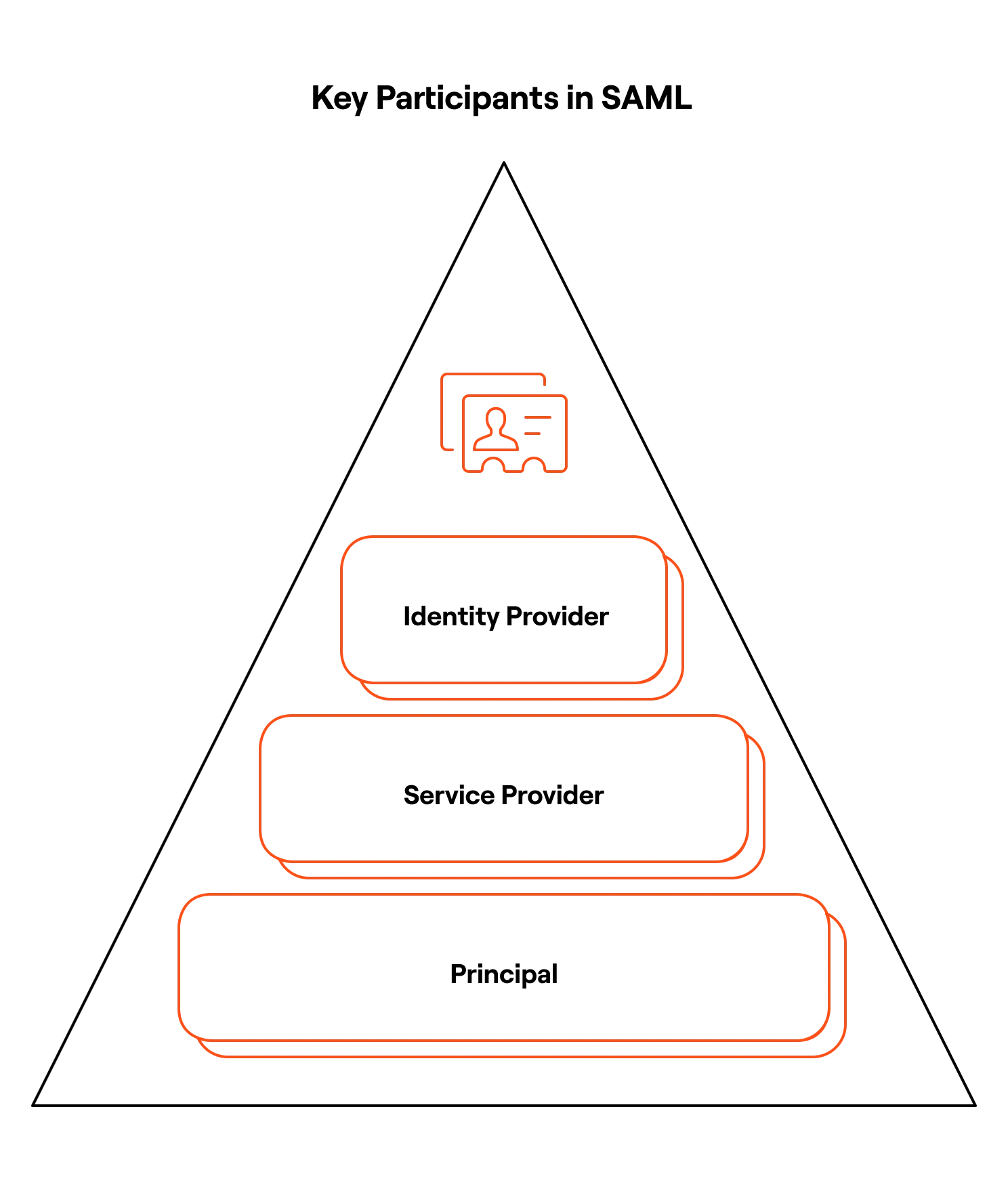
SAML involves three primary entities that work together to enable secure, seamless authentication and authorization across different systems. Each participant plays a distinct role in facilitating identity federation, ensuring that users can access multiple services without repeatedly entering credentials.
- Identity Provider (IdP)
- Service Provider (SP)
- Principal (User)
Identity Provider (IdP)
The Identity Provider (IdP) is the central authority responsible for authenticating users and asserting their identity to other systems. When a user attempts to access a service, the IdP verifies their credentials – typically through passwords, multifactor authentication (MFA), or single sign-on (SSO) – and issues a SAML assertion, a digitally signed XML document containing identity and access information.
IdPs such as Okta or Microsoft Entra ID (Azure AD) act as trusted intermediaries between users and service providers. They validate the authenticity of users and communicate this verification securely, allowing downstream applications to grant access without storing or processing credentials directly. By centralizing authentication, the IdP simplifies credential management, enhances security, and supports compliance initiatives through consistent policy enforcement.
Service Provider (SP)
The Service Provider (SP) is the application or system that relies on the Identity Provider to verify a user’s identity before granting access. Examples include SaaS platforms like Salesforce, Google Workspace, or AWS Management Console.
When a user requests access, the SP redirects them to the IdP for authentication. Once verified, the IdP returns a SAML assertion to the SP, which validates the digital signature and uses the embedded attributes – such as username, role, or group membership – to determine what level of access to grant. This trust-based relationship between the SP and IdP is formalized through metadata exchange, which defines endpoints, certificates, and security protocols.
Principal (User)
The Principal, or user, is the individual requesting access to a service. In a SAML flow, the principal initiates the authentication process, usually by attempting to access a protected application. The user doesn’t interact directly with SAML assertions or tokens; instead, the SAML framework handles authentication transparently, passing trust between systems.
From the principal’s perspective, SAML provides a seamless, single sign-on experience; one login enables access to multiple services governed by the same identity provider. This reduces password fatigue, improves productivity, and enhances security by minimizing credential reuse.
Benefits of SAML
SAML provides a standardized way for organizations to manage authentication and authorization across multiple systems. By decoupling identity from individual applications, SAML enables seamless access, centralized control, and stronger security posture; key priorities for IT and security leaders managing complex hybrid or cloud environments.
Streamlined User Experience
One of the most significant benefits of SAML is the streamlined user experience it delivers through Single Sign-On. With SAML-based SSO, users authenticate once through a central Identity Provider and gain access to multiple applications without needing to re-enter credentials for each one.
This unified approach improves user satisfaction, productivity, and operational efficiency by eliminating repetitive login steps across corporate portals, SaaS platforms, and internal tools. Employees spend less time managing passwords and more time focusing on their tasks, while IT teams reduce the volume of password reset tickets.
For organizations adopting hybrid or multi-cloud environments, SAML’s interoperability ensures users enjoy consistent and secure access across diverse systems, regardless of location or device.
Enhanced Security
SAML significantly enhances security by reducing reliance on password-based authentication, a major vulnerability in modern IT environments. Because authentication is centralized through an IdP, users do not store credentials across multiple service providers—minimizing the risk of credential reuse, phishing, and data breaches.
Additionally, SAML assertions are digitally signed and encrypted, ensuring data integrity and authenticity between the IdP and SP. These signatures prevent tampering and unauthorized interception, safeguarding sensitive identity data in transit.
By integrating multi-factor authentication (MFA) and contextual access policies at the IdP level, organizations can further harden their defenses to ensure that authentication decisions factor in device health, location, and user behavior before granting access.
Centralized Access Control
With SAML, administrators gain centralized control over identity and access policies. All authentication decisions flow through the IdP, allowing IT teams to enforce organization-wide rules from a single platform rather than managing access independently across multiple systems.
This centralized management simplifies provisioning and deprovisioning, ensures consistent enforcement of security policies, and supports regulatory compliance frameworks such as SOC 2, ISO 27001, and GDPR.
SAML’s built-in auditability provides detailed visibility into user access events, enabling effective monitoring and faster incident response.
Challenges and Limitations of SAML
While SAML remains a cornerstone of federated authentication, it’s not without its drawbacks. As IT and security leaders modernize their identity architectures, they must navigate the technical, operational, and architectural challenges that accompany legacy protocols like SAML.
Complexity of Configuration and Integration
Implementing SAML requires significant configuration effort, especially for organizations managing multiple IdPs and SPs. Each connection demands proper exchange of metadata, certificates, and endpoint mappings; all of which must align precisely to prevent authentication failures.
Unlike newer identity standards that rely on JSON or REST APIs, SAML’s XML-based format can be verbose and error-prone. A single misplaced tag or mismatched certificate can break the authentication flow. Troubleshooting is often challenging because error messages returned by SPs or IdPs tend to be cryptic, making debugging a time-intensive process.
Moreover, managing SAML certificates adds another layer of complexity. Certificates must be rotated periodically to maintain trust, and failure to do so can lead to service disruptions. Without automation or centralized visibility, even routine maintenance becomes a potential failure point for access continuity.
Vendor Interoperability Issues
Although SAML 2.0 is an open standard, vendor interoperability remains a recurring issue. Different identity providers and service platforms sometimes interpret SAML specifications differently, leading to subtle inconsistencies in implementation.
For instance, some IdPs may require custom attributes, nonstandard NameID formats, or proprietary binding preferences that don’t align with the SP’s expectations. This lack of uniformity often forces administrators to create custom mappings or transformation rules, which undermines SAML’s intended simplicity and scalability.
Integrating cloud applications from various vendors can also exacerbate these issues, as not every SaaS provider fully supports the same SAML profiles (e.g., Single Logout or Artifact Binding). Consequently, IT teams may have to maintain multiple configuration variants – an approach that introduces both operational overhead and long-term technical debt.
Limited Support for Modern, Dynamic Environments
SAML was designed in an era of web-based enterprise applications, not for today’s hybrid and cloud-native environments. Its architecture assumes browser-based access and doesn’t naturally extend to modern use cases such as API security, mobile authentication, or microservice communication.
This limitation is especially evident in dynamic, distributed systems where token lifetimes, session persistence, and real-time policy evaluation are critical. In contrast, newer frameworks like OpenID Connect (OIDC) and OAuth 2.0 offer lightweight, API-friendly mechanisms better suited for these workloads.
How SAML Works
Security Assertion Markup Language facilitates federated identity management by securely exchanging authentication and authorization data between a user’s IdP and a SP. The process ensures that users can access multiple applications through a SSO experience without repeatedly entering credentials.
SAML operates using XML-based protocols, digital signatures, and encrypted assertions that allow systems to trust one another’s authentication decisions. Understanding how SAML works begins with the authentication flow and the core assertion mechanisms that make secure identity exchange possible.
SAML Authentication Flow
The SAML SSO flow follows a defined sequence of interactions between the user (principal), IdP, and SP. Here’s a step-by-step breakdown of a typical SP-initiated and IdP-initiated process:
- Access Request: The user attempts to access a service provider’s application.
- Authentication Request: The SP generates a SAML request and redirects the user to the IdP for verification.
- User Authentication: The IdP authenticates the user through credentials, MFA, or session tokens.
- SAML Assertion Creation: Once authenticated, the IdP generates a signed SAML assertion containing identity and attribute information.
- Assertion Response: The IdP sends this assertion back to the SP, typically through the user’s browser using HTTP POST or Redirect bindings.
- Validation and Access: The SP validates the signature and attributes, then grants access based on policy rules.
SP-Initiated vs. IdP-Initiated Flows:
- In SP-initiated SSO, the process begins when the user attempts to access a service. The SP triggers the authentication request.
- In IdP-initiated SSO, the user starts from the IdP’s portal. After successful authentication, the IdP sends a SAML response directly to the SP to log the user in.
Both flows rely on mutual trust established through certificates and metadata exchange, ensuring secure transmission and validation of assertions.
SAML Assertions and Protocols
SAML assertions are XML documents that communicate identity and authorization data from the IdP to the SP. There are three main types of assertions:
- Authentication Assertions: Confirm that the user has been successfully authenticated and specify the method used (e.g., password, MFA).
- Attribute Assertions: Include user details such as username, department, or role—helping SPs determine access rights.
- Authorization Decision Assertions: Indicate whether the user is permitted to perform a specific action on a given resource.
These assertions are transported via SAML requests and responses, which follow the SAML 2.0 protocol. The IdP issues the assertion, digitally signs it, and sends it securely to the SP, which validates it before granting access.
SAML Components and Architecture
SAML operates through a well-defined architecture composed of interoperable components that enable secure, standards-based identity exchange between an Identity Provider and a Service Provider. Understanding these components – along with how SAML structures data, communicates over protocols, and defines use cases – is essential for IT and security leaders deploying federated authentication in hybrid or cloud environments. These components include:
- Core Elements
- SAML Profiles
- Bindings and Communication
Core Elements
The SAML architecture is built around four core elements: Assertions, Protocols, Bindings, and Profiles.
- Assertions are XML documents that communicate authentication, authorization, or attribute information from the IdP to the SP. These digitally signed assertions are the foundation of trust within SAML exchanges.
- Protocols define how SAML requests and responses are structured and transmitted. The most common example is the SAML Authentication Request Protocol, which governs how the SP requests authentication from the IdP.
- Bindings specify how SAML messages are transported across networks, typically using HTTP or SOAP.
- Profiles combine these elements into practical use cases, such as web-based SSO.
Each SAML component relies on an XML-based structure, ensuring interoperability across diverse platforms. SAML metadata files, typically in XML format, describe the endpoints, certificates, and entity identifiers that establish trust relationships between the IdP and SP.
SAML Profiles
SAML Profiles define specific combinations of assertions, protocols, and bindings tailored for common identity federation scenarios. The three most widely used profiles include:
- Web Browser SSO Profile: The most common SAML use case, this profile enables users to authenticate once with the IdP and access multiple web applications without re-entering credentials.
- Single Logout (SLO) Profile: Extends SSO by allowing users to terminate sessions across all connected SPs simultaneously when logging out from the IdP.
- Name Identifier Management Profile: Facilitates the creation, update, or reassignment of user identifiers between the IdP and SP, ensuring consistent identity resolution across systems.
These profiles make SAML adaptable to real-world enterprise environments by providing flexible authentication and session management capabilities.
Bindings and Communication
SAML messages rely on bindings to define how information is exchanged between systems. The most common methods include:
- HTTP POST and Redirect Bindings: Widely used in browser-based SSO flows, where authentication data is passed through form submissions or URL parameters.
- SOAP Binding: Used primarily for back-channel communication, such as artifact resolution or single logout requests.
- Artifact Binding: Instead of transmitting the entire assertion via the browser, only a small artifact (or reference) is sent, which the SP later exchanges directly with the IdP over a secure channel.
Together, these bindings ensure reliable, secure communication regardless of the transport mechanism or network topology.
SAML Versions and Specifications
Over the years, Security Assertion Markup Language has evolved to meet the growing demands of enterprise identity federation and secure authentication. The two most significant versions, SAML 1.1 and SAML 2.0, represent key milestones in improving interoperability, flexibility, and scalability across cloud and hybrid environments. Understanding their differences, along with how metadata establishes trust, helps IT and security teams deploy more resilient identity architectures.
SAML 1.1 vs. SAML 2.0
SAML 1.1, released in 2003, introduced the foundational concepts of federated identity by allowing an IdP to authenticate users for SPs. However, it had several limitations, including minimal interoperability across vendors, fragmented binding support, and a lack of robust session management.
In contrast, SAML 2.0, standardized by OASIS in 2005, represented a major leap forward. It unified earlier efforts from the Liberty Alliance and other federated standards into one cohesive framework. Key enhancements included:
- Single Sign-On (SSO) and Single Logout (SLO): Seamless authentication and session termination across multiple services.
- Enhanced Binding Support: Inclusion of HTTP POST, Redirect, and Artifact bindings for flexible communication between IdPs and SPs.
- Improved Attribute Sharing: Richer support for user attributes, enabling fine-grained access decisions.
- Standardized Metadata Exchange: Simplified configuration and trust establishment between parties.
- Broader Federation Support: Compatibility across different domains, organizations, and cloud services.
Because of these improvements, SAML 2.0 became the global standard for web-based SSO and identity federation. It remains widely used in enterprise identity platforms such as Okta and Azure AD, even as newer protocols like OpenID Connect (OIDC) gain traction for modern applications.
Metadata and Trust Relationships
Metadata plays a central role in establishing trust between SAML entities; namely, the IdP and SP. Each entity publishes a metadata XML file that defines its unique identifiers, endpoints, supported bindings, and public signing certificates. This file acts as a digital “contract” that allows both sides to validate and authenticate communications securely.
- Identity Provider Metadata typically includes the IdP’s Single Sign-On URLs, logout endpoints, and public keys for signing and encryption.
- Service Provider Metadata contains the SP’s Assertion Consumer Service (ACS) endpoints, entity IDs, and certificate information.
When these metadata files are exchanged, they establish a trusted federation relationship, eliminating the need for manual configuration of certificates or endpoints. This trust ensures that SAML assertions are transmitted only between verified parties.
SAML in Modern Identity Ecosystems
Although newer identity standards have emerged, SAML continues to play an integral role in today’s authentication and authorization landscape. Rather than being replaced, it operates alongside complementary protocols; each optimized for specific use cases within modern identity and access management (IAM) ecosystems.
How SAML Fits Alongside OAuth, OpenID Connect, and SCIM
SAML primarily handles authentication within web-based environments. However, as application architectures evolved toward APIs, microservices, and mobile-first access, newer standards emerged to address different needs:
- OAuth 2.0 focuses on authorization, allowing users to grant limited access to their resources without sharing credentials (e.g., permitting an app to access calendar data).
- OpenID Connect (OIDC) builds on OAuth by layering in an authentication component using JSON-based tokens, making it more lightweight and API-friendly than SAML.
- SCIM (System for Cross-domain Identity Management) complements both OAuth and SAML by automating user provisioning and deprovisioning across applications, ensuring that identity lifecycles remain synchronized.
In this ecosystem, SAML continues to serve as the federation backbone for enterprise web applications. Many organizations adopt a hybrid identity model, using SAML for enterprise-grade SSO alongside OIDC for modern, cloud-native services and SCIM for automated account management.
This interoperability underscores a key principle of modern IAM: there is no one-size-fits-all standard. Instead, organizations leverage the strengths of each protocol to create a cohesive, secure, and adaptable access management framework.
Continued Relevance in Enterprise and Hybrid Cloud Settings
Despite being over two decades old, SAML remains deeply entrenched in enterprise identity infrastructure – particularly within regulated industries like finance, healthcare, and government. Its enduring popularity stems from three main factors: maturity, interoperability, and trust.
- Maturity and Proven Security: SAML 2.0 is a well-established, thoroughly vetted standard with a strong security record. Enterprises continue to rely on it because of its predictability and broad vendor support.
- Hybrid Cloud Compatibility: Many organizations still maintain a mix of on-premises Active Directory environments and cloud-based applications. SAML bridges these domains by providing federated authentication that supports both legacy and SaaS ecosystems.
- Compliance Alignment: SAML’s built-in features help organizations meet audit and regulatory requirements like SOC 2, HIPAA, and ISO 27001.
As identity systems evolve toward Zero Trust and context-aware access, SAML continues to play a complementary role. It acts as a trusted bridge connecting traditional IT assets with cloud-native systems governed by OAuth, OIDC, and SCIM.
Strengthening Identity Security with SAML and Lumos
SAML continues to hold a vital role in enterprise identity management: enabling reliable single sign-on, federated authentication, and reduced password fatigue across hybrid and cloud environments. Its maturity, broad adoption, and strong support make it a dependable foundation even as newer protocols like OAuth and OpenID Connect evolve. For security leaders, SAML remains a trusted tool in the identity toolbox.
Lumos amplifies the value of SAML by embedding it within a comprehensive identity governance framework. With Lumos, SAML integrations are not just connections; they become enforceable, auditable governance points. You gain:
- Automated provisioning and deprovisioning tied to your lifecycle policies
- Unified access policies enforced across SAML and non‑SAML systems
- Granular visibility into who has SAML access, when it’s used, and whether it remains justified
- Intelligent automation to detect and remediate overprovisioned SAML entitlements
By unifying identity governance with SAML controls, Lumos helps shrink blast radius, enforce least privilege, and simplify access management at scale across hybrid environments.
If you're ready to move beyond “just federated login” and toward a smarter, governed SAML strategy, book a demo with Lumos today. Discover how you can unify integration, governance, and automation under one roof; and take identity security to the next level.






Don't let any identity become your next breach.
Govern every human, machine, and AI in your business with a free identity assessment today.
Book a Demo
The autonomous identity platform. Agents that continuously govern access for every human, machine, and AI.